



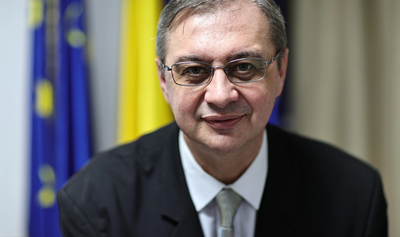


The war in Ukraine will end after Vladimir Putin is removed from power or when resources are exhausted, political analyst Iulian Chifu believes.
In a statement to AGERPRES marking four years since the start of the Russian Federation's military aggression against Ukraine, Iulian Chifu, director of the Centre for Conflict Prevention and Early Warning, said that this military conflict will end 'when Russia substantially exhausts its resources to such an extent that the group of oligarchs who pay for the war and the circles around the Kremlin decide to remove, to retire Vladimir Putin and his group.'
According to the political analyst, 'there will be no stopping the war until Putin is removed.' 'When I refer to removal, I mean removal from the sphere of power, of course. However, Russian history shows us that the removal of Russian leaders, with the exception of the two who had democratic inclinations, took place in a far more violent form,' he said.
In his view, the peace plans agreed trilaterally by the United States, the European Union and Ukraine will reach the stage where they can be implemented once a substantial change has taken place in Russia in one of two directions - the removal of the leader and his group, the exhaustion of resources and increasing pressure from the population regarding the channelling of resources to the front without any motivation and without any prospect.
As regards the current peace negotiations, Iulian Chifu says it is very important that the United States of America, the European Union and Ukraine have aligned their positions on the 20-point plan and that the security guarantees envisaged and put on the table have been agreed.
'It is very important and the other bilateral understandings, security guarantees, whether multilateral or bilateral with the United States regarding prosperity or reconstruction elements, are also very important. These can sustain the war effort,' the political analyst added.

According to him, the war as such has not in itself altered the geopolitical balance, but the existence of the war has triggered alertness at least on the Eastern Flank, in this context giving the example of Sweden and Finland, initially neutral states that joined the North Atlantic Alliance.
'And immediately afterwards, combined with the discussion about the transfer of responsibilities in the area of European security and defence from the United States to Europe, we had an alert, a double alert, embraced by the European Union, by the Coalition of the Willing - here we must also include the United Kingdom and the other actors - first to support Ukraine so that it can stop Russia and defend itself, secondly to prepare Europe for defence and deterrence given that the United States retains, according to its national defence strategy, only the nuclear umbrella and critical elements, as stated there, of support for Europe. The same doctrine makes it clear that Article 5 of the North Atlantic Treaty remains valid, therefore, if necessary, the United States will be present alongside its allies in the event of an attack on an ally,' Iulian Chifu explained.
He highlighted that there is a degree of fragmentation in Europe regarding support for Ukraine.
'We can isolate, if you wish, Hungary and probably other states externally, but we also find such views within states, among certain categories of political forces, generally in the populist, extremist, so-called sovereignist and, let us say more recently, pro-Trumpist sphere, which in fact masks the pro-Russianism of these forces. Because it looks good, the relationship with America is viewed far more positively and so, if you replace pro-Russianism with pro-Americanism, pro-Trumpism, you gain a form of prestige and, in a way, greater acceptability among your own populations. So all these political components within states can indeed have distinct, differing options,' Iulian Chifu stressed.
The political analyst finds that the sanctions imposed on the Russian Federation 'have worked in the long term.'
'We can look at the economic situation. The point where I have reservations is that Russia is a dictatorship, even a personal dictatorship of Putin, which means it allows itself to take resources from the civilian sphere, from funding or balancing the budgets of the regions and other components of the federation, and move them towards the war effort, which it does. At the same time it has increased taxes and duties, including VAT, placing the costs of his adventure in Ukraine on the shoulders of the population. Not to mention the human resource component it is grinding down. In practice, Vladimir Putin has destroyed his state, his country for generations to come. It already had demographic problems before the war began. At present, the meat grinder he uses, because he has no regard whatsoever for human life or the risks taken, as usually happens on the front line, exposes and loses many people, generally young people of childbearing age and working age, and these things, already over four years, but even more so in the future, will matter,' the political analyst said.
Iulian Chifu underlined that, at the level of sanctions, the most important point is the substantial reduction of revenues from oil and gas, which before the war, in 2021, accounted for 50 per cent of the Russian Federation's budget.
'First the sanctions, then the price cap, subsequently the tightening of secondary sanctions, see Donald Trump in relation to India (...), and action against the shadow fleet transporting this oil, probably the sum of these measures has a major effect, first and foremost on financial resources, but it certainly exerts substantial pressure on Russia's effort to win, to achieve its maximalist objectives formulated by Vladimir Putin,' the expert says.
As regards Romania, Iulian Chifu said that the country has fulfilled 'its share of responsibility' in supporting Ukraine.
'First, we are neighbours, second, there are two mandatory transit routes to reach Ukraine with aid. We had responsibility regarding refugees in the initial phase of the war, support of all kinds, multi-faceted, which has continued consistently in the energy, humanitarian and military spheres, economic transit and exports carried out through Romanian territory, the opening of numerous new border crossing points, precisely for the same reason, to facilitate this transit and Ukraine's exports. So multiple formulas, certainly including direct military assistance, including, as we saw last year, although we were in excessive deficit, Romania contributed 50 million euros to that programme for the purchase of armaments from the United States for Ukraine and probably as this corset, arising from the need for economic readjustment and the elimination of deficits, is left behind and achieved, Romania will also prepare much more, including with a view to post-conflict reconstruction,' the political analyst explained.
In his view, the European accession of Ukraine and the Republic of Moldova could take place as early as next year, despite obstacles. 'Until then we may indeed see the start of negotiations, because at present they are taking place at a technical level, but at political and formal level they have not been able to proceed due to the blockage of the Hungarian veto. We have elections in Hungary in April. It is possible, following these elections, depending on the result, that we may either have a natural unblocking or that the Commission, the European Union, the European Council will resort to extraordinary instruments to circumvent Hungary's veto and launch such a process,' Iulian Chifu maintained.
Thus, as he showed, the possible accession would also open the way for aspiring states in the Western Balkans.
'It deserves this special note at the moment when Ukraine enters the European Union and in this form the Republic of Moldova will take this step too, with the amendment that subsequently, on the basis of individual merit, on the basis of negotiations on each chapter and legislative and institutional adjustments, each of the two, plus the other Western Balkan countries, will be able to gain step-by-step access to decision-making, therefore to voting rights in the areas in which they have adjusted their legislation and integrated into Europe,' Iulian Chifu also said.











Comentează