



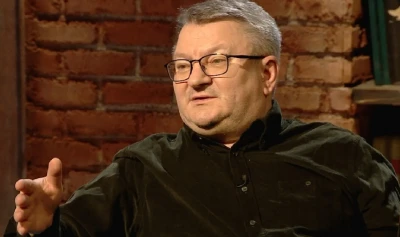


Ukraine's accession to the European Union, in one form or another, could be the salvation of this country, but also of Europe, historian and political analyst, an expert on the former Soviet sphere, Armand Gosu said.
"Ukraine's accession, in one form or another, because it can join only under certain chapters, could be both Ukraine's salvation, but not just for Ukraine, it is also Europe's salvation, because Ukraine has the only capable army that can manage a modern war such as the one it is waging in defence against Russia," Armand Gosu told AGERPRES.
Four years after Russia started a large-scale invasion in Ukraine, the historian notes that the political balance has been changed, including with the rise to power of US President Donald Trump.
"Today, things look different compared, for instance, with the autumn of 2024, this is because of Trump. Certainly, these geopolitical changes are difficult to process, to metabolize, but they are some major geopolitical changes, they may be in the long-term or may depend on Trump's presence at the White House. But in what way? It is a strengthening of both Russia's position and Europe's position, as the European Union, as something distinct that opposes Russia and a retreat of the United States in the past year," Gosu said.
Beyond the political divisions, he also pointed out an ideological shift in this context.
"We are witnessing a strengthening of authoritarian regimes and an enormous pressure which these authoritarian regimes, and I'm referring here to Putin, to Orban, Erdogan and now Trump, or perhaps above all Trump, place on the liberal, democratic regimes, which are typical of the Western world," the expert believes.
He argued that the sanctions imposed to Russia in the context of the war are having effects. "The Russian economy is exhausted, the Russian finances are drained, a good part of the military capabilities are affected by these sanctions, which, certainly, seem minor. People criticize them because it's fashionable to criticize, but I believe the West had no other option than these sanctions and their effects are now beginning to show, they started in 2024-2025, but the impact of these sanctions is becoming increasingly visible," Armand Gosu explained.

Regarding the development of the conflict, he says that it could become low intensity, meaning the intensity of the fights on the Ukrainian fronts may decrease.
"At the same time, I believe that these are the last months, because on 3 November the US midterm elections will take place, which could change the political color of the Congress. I do not know whether Democratic majorities will be established there. They could begin impeachment proceedings, which would somewhat limit these measures and Trump's policies, particularly the controversial aspects of his foreign policy. We have seen actions from him that were outright anti-Ukrainian and pro-Russian, pro-Putin during this period. Thus, Putin does not have much time left," the political analyst believes.
According to him, in a few weeks, Russia is launching a new partial mobilisation, needing 300,000-500,000 people to send to the front "in order to force the victory this summer, that is, before the elections at the beginning of November, or accept that it fails to mobilize more resources and will then wage a low-intensity, limited war."
A continuation of the war, according to the analyst, could lead to a political instability, preventing Ukraine to rebuild, to access the European Union and pushing countries like Romania, Poland, the Baltic states and the Nordic countries to spend a large proportion of the GDP for endowment.
"We see that the fear of Russia is wreaking turmoil, forcing us all to rearm," Gosu said.
The analyst did not rule out a further escalation of the conflict. "There are Russian analysts who say that, at this moment, Putin, through the measures adopted in Moscow - social media controls, plans to block Telegram on 1 April, WhatsApp already blocked, new networks established under the control of authorities and intelligence services is aiming to prevent real news from reaching ordinary citizens, keeping them fed with propaganda, making it easy for the state to manipulate them. At the same time, this blocks the transmission of important information about what is happening in Russia, inside Russia and beyond. We believe something similar happened during the recent protest movements in Iran," the political analyst mentioned.
Armand Gosu believes that the peace negotiations "won't lead nowhere" being rather more of a show.
"All these negotiations are for one man, for Trump. (...) Trump is unpredictable, you have to convince him of something, and it is a competition between Putin and the West over who can fool Trump. The West, naively, believed that simply revealing the truth to Trump, putting evidence on the table, would be enough. It seems Trump doesn't work that way. And so you see this competition. It is a battle for the man's mind, for his brain, to put it more accurately. And this battle is between different stories, narratives, a battle of narratives. Russia comes with its narrative - this is a huge, organised stage with many characters and in the room there is only one man - Trump," the analyst said.
Referring to a recent INSCOP poll, Armand Gosu argued that "the Russians have won the battle of narratives in Bucharest, in Romania." "Probably results this disastrous are not found in other countries in the European Union or NATO, but in each of these countries it is different, they are higher, the resilience of public opinion, the way political decision-makers get involved, the way intelligence services do or do not do their duty varies from country to country, yet Putin is pursuing, and we see in the case of Romania with considerable success, the weakening of European unity, the weakening of the support that EU member states give to Ukraine and to Ukraine's fight for freedom against Russian aggression," he explained.
Moreover, he argued that in terms of the discourse related to the war in Ukraine, "secrecy continues" in Bucharest. "Too little has come from President Dan or his public spokespersons, such as presidential advisers, such as ministers. Apart from the Defence Minister and the Foreign Affairs Minister, who seemed to me to follow Western scripts, I have not seen the president, the prime minister, or, I do not know, a presidential adviser, nor the Interior Minister come out and say: 'look, what we have done for refugees, how we help, how we act,'" the analyst pointed out.
The expert further said that the information war has been won in Romania and quoted the same INSCOP poll, which shows that a majority of Romanians do not want to offer military help to another country if it is attacked. "It is hard for me to imagine that anyone from Western Europe will come here to fight and defend us against the Russians. Thus, I am not necessarily saying we are on our own, of course NATO functions within certain parameters, but I see that within NATO a subgroup is already forming that fears Russia and is consolidating, this group is made up of the Scandinavian countries, the Baltic states, Poland and Germany," Gosu underlined.
In this context, the analysts believes that "probably Romania is in a worse historical moment than in 1940."
"(...) No, we do not know what to do, we have not learned this, we are caught in a very bad historical moment, probably Romania is in a worse historical moment than in 1940. We are in a deep political crisis, a crisis of trust in Romanian institutions, profound, ten years of Iohannis have left Romania on its knees, simply, and we have no way of recovering anytime soon. That is all - we pray to God and hope that our historical, proverbial luck will save us this time as well," Armand Gosu said.
The political analyst underscored that it is in EU's interest to include Ukraine and called for a reform of the European community.
"It is in our interest, as Europeans, to bring Ukraine into the EU, while at the same time reforming ourselves, changing the structure of the European Union, transforming it from a confederation into a federation, because if we do not hurry and get to work, if we do not speed up the reform of the institutions, we will simply be knocked down by these great centres of power: Russia, China, the United States. And all of them will carve up pieces of the European Union. The idea is that we, in turn, must resist, the European Union, Western Europe, yes? That is where we have wanted to be for many years, where we always want to be, we must move quickly and reform. I believe there are chances, that is, I do not credit those who keep singing the death knell of the West, of the European Union, always burying it and the poor thing does not want to die," Armand Gosu said.









Comentează