



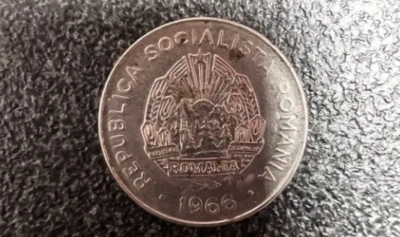


The hoard of Mircea the Elder, Voivode of Wallachia, comprising more than 6,000 coins, is on display at the History Museum in Targoviste, illustrating the independence and economic strength of Wallachia during that period.
The hoard was discovered in 1963 by a local resident in his yard while carrying out agricultural work, in what is now the Suseni area of Targoviste. The coins, part of the museum's collection, carry particular significance this year, marking 640 years since Mircea the Elder's accession to the throne and 630 years since the first documentary attestation of Targoviste.
"Targoviste, the old citadel, is marking a year of celebration.. A German knight passing through Wallachia during Mircea [the Elder]'s reign noted years later: 'I have been to Wallachia and its two capitals, Arges and Targoviste.' This is, in effect, where the story of Targoviste begins. If we were to imagine ourselves back in 1396, when the town was truly taking shape as a princely seat, we would find here an extraordinary monetary hoard - indeed known as the treasury of Mircea the Elder," museum curator Irina Cirstina of the Princely Court National Complex in Targoviste told AGERPRES on Monday.
The pot in which the coins were found also contained a small proportion, around 1%, of coins minted by all three of Mircea's predecessors.
"We have coins from Sigismund of Luxembourg, a Venetian coin and a Serbian coin. This points to Targoviste as a centre of power, evidenced by the impressive quantity of coins, showing it was an important commercial settlement. Notably, Mircea the Elder appears in person on the coins. This had also occurred earlier under Radu I, but Mircea[the Elder] is depicted on some coins in Western attire and on others in Byzantine dress. That suggests being between two worlds. The inscription 'Io Mircea Voievod' ('I, Mircea the Ruler') appears on thousands of coins, some likely minted in Targoviste," the museum curator added.
The silver coins weigh a total of 2.9 kilogrammes, each weighing between 0.3 and 0.5 grammes.
"It is not known exactly which were minted in Targoviste, but it is believed there was also a mint here. After Mircea's reign, coin minting continued but declined significantly. By around 1500, under Radu the Great, coins were no longer issued, nor were they under his father Vlad Calugarul. The peak of minting - symbolising independence and economic strength - was during Mircea the Elder's rule, followed by decline. Even the renowned Vlad Tepes issued very few coins. (...) Only in 1867, during the reign of King Carol, was the issuance of a national currency resumed. It is therefore significant for economic history, for this sphere of power and, ultimately, for the city of Targoviste. Of all the hoards ever discovered in Targoviste, none is larger or more significant than this one," the curator said.
The story of the hoard also sheds light on the origin of the Romanian expression "ti-ai dat arama pe fata" (to reveal one's true nature).
"Mircea the Elder and both his predecessors and successors minted only silver coins, but Mircea used high-quality silver. Counterfeits existed even in his time, identifiable by the reddish copper beneath the worn silver coating. The expression originates from this literal meaning," Irina Cirstina explained.


Some coins even depict Jesus Christ. Mircea the Elder appears on one side, while on the reverse Christ is shown blessing with his right hand and holding the Gospel in his left. On other coins, the coat of arms of Wallachia is also present.
"Essentially, the coat of arms of Wallachia appears on this very small piece of metal. It features a shield, a helmet and the Wallachian eagle, shown with its head turned, holding a cross in its beak. On such a small piece of metal we find a wealth of information. Why is this important? Because it represents a history that can no longer be altered. While written records or certain facts may be reinterpreted over time, the coin is an authentic document. It comes directly from the time of Mircea the Elder to us. It cannot be recreated - it was minted then, and its story reaches us unmediated, which I find extraordinary. Numismatics is indeed an extremely valuable way of understanding the past directly, offering a direct link to the issuer," the curator at the Princely Court National Complex in Targoviste added.
























Comentează