



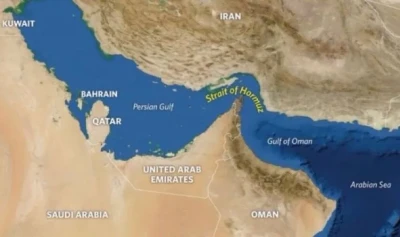


The complete closure of the Strait of Hormuz would remove approximately 13.5 million barrels per day from the market, given that around 20 million barrels of crude oil and petroleum products transit this corridor daily, equivalent to nearly one fifth of global consumption, according to an analysis carried out by Asociatia Energia Inteligenta (AEI) president Dumitru Chisalita.
'The Strait of Hormuz is not just a point on the map. It is the world's energy artery. Through this narrow corridor between Iran and Oman normally pass approximately 20 million barrels per day of crude oil and petroleum products, almost 20% of global consumption,' Chisalita noted, agerpres reports.
He underlines that, in the absence of a direct maritime alternative, a complete blockage would have an immediate effect on global energy flows. 'There is no direct maritime diversion. If Hormuz closes completely, the global market instantly loses access to one fifth of its vital energy flow,' the author of the analysis says.
According to MarineTraffic data quoted in the analysis, around 250 vessels were waiting to enter or exit the strait at the beginning of March, including roughly 150 crude oil and LNG tankers anchored in the Persian Gulf and around 100 cargo ships and oil tankers near the coasts of the United Arab Emirates and Oman.
In the scenario of a total blockage, the only realistic alternative would be transport via pipelines to ports located outside the Persian Gulf. Saudi Arabia's East-West pipeline has a capacity of around 5 million barrels per day, while the Habshan-Fujairah pipeline in the United Arab Emirates can transport approximately 1.5 million barrels per day.


'Normal flow through Hormuz: 20 million barrels per day. Alternative pipeline capacity: 6.5 million barrels per day. Gross deficit: 13.5 million barrels per day. This means approximately 13% of global production,' Chisalita explains.
For comparison, he recalls that the 1973 oil shock reduced global supply by about 7%. 'Here we are talking about double that,' the AEI president points out.
As for the capacity to offset such a shortfall, the analysis indicates that increased production in other countries could bring an additional 0 to 0.5 million barrels per day within two weeks and between 1 and 2 million barrels per day within three months, while global strategic stocks, estimated at around 1.5 billion barrels, could temporarily cushion a major deficit.
'Strategic stocks can absorb a temporary shock, but they do not eliminate it completely if the deficit is large and prolonged,' Dumitru Chisalita argues.
According to him, such a supply shock would have knock-on effects on the global economy through inflationary pressures, higher logistics costs and an impact on economic growth rates.

























Comentează