



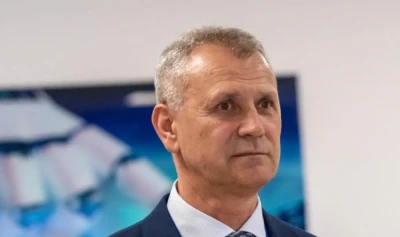


The fact that the United States and the Russian Federation have not renewed their nuclear disarmament treaty does not automatically mean the world is on the brink of nuclear war, nor that the two arsenals will suddenly change or trigger an accelerated arms race, retired General Stefan Danila, former Chief of Defense Staff, told AGERPRES on Thursday
His remarks come as the Treaty on Measures for the Further Reduction and Limitation of Strategic Offensive Arms, known as New START, expires on February 5.
"This treaty was very important because it provided a legal framework for limiting the number of nuclear warheads and ensuring transparency through on-site verification. It was a first step, not toward nuclear disarmament, but toward limiting nuclear warheads, especially strategic ones. It does not cover tactical missiles, but refers primarily to the strategic arsenal, the intercontinental missiles," the former Chief of Defense explained.
According to (ret.) General Danila, the failure of the two major signatories - the United States and the Russian Federation - to renew the treaty "does not automatically mean we are on the verge of a nuclear war or that the arsenals will suddenly change and we will witness an accelerated nuclear arms race".
"Of course, we can now suspect that both states will move to modernize their existing arsenals and perhaps even relocate systems before the treaty expires, because transparency is gone and mutual inspections are no longer possible. From what we know, including from President Donald Trump's statements, one of the reasons he did not want to extend the treaty was his intention to include China in a future agreement, to create a broader framework that also covers China and perhaps India or other states with nuclear capabilities," he said.
In this context, General Danila noted that the U.S. president wants a wider framework, "not just the one established during the Cold War between the United States and the Russian Federation". He also does not believe the expiration of New START will immediately trigger new exercises or nuclear tests.


"Nuclear tests are frozen under another treaty, which has not yet been ratified. (...) So from this perspective, we could see nuclear tests, although we have not heard anything so far. But the possibility exists, given the current tensions and the war in Ukraine, which represents not only the positioning of the Russian Federation as an aggressor state, but also the positioning of European states and the U.S. against that aggression," General Danila said.
He also addressed the situation of European nuclear powers.
"Great Britain and France have not yet been party to a nuclear weapons treaty because they do not have a significant number of warheads. But given Europe's intention to reduce its significant dependence on the United States, there is a possibility that European states may want to join such a treaty, not to expand or produce new warheads, but to limit the existence of nuclear warheads in other states," the retired general said.
At the same time, he warned that the current context also brings risks. "Even before the treaty expired, we heard various voices from the Russian Federation issuing threats about the use of nuclear means. These threats pose a higher risk for us, because Russia no longer has the limits imposed by the treaty. The fact that nuclear warheads, strategic bombers and missiles can no longer be controlled - not only in number but also in deployment - represents a significant risk for the European Union," he pointed out.
General Danila also commented on the prospect of including China in a future agreement.
"President Trump talked about China joining a new treaty, but I think China also wants to be part of such an agreement, because that puts you at the table as a great power. Even if you don't have the same nuclear capacity as the others, you enter the game and become part of the group that sets the limits. For China, being accepted into the group of states that set the maximum level of nuclear weapons would be a major achievement," he emphasized.
***
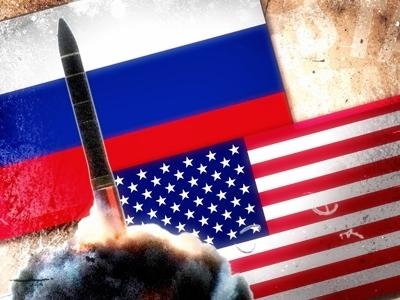
The last remaining nuclear disarmament treaty between the United States and Russia expires on Thursday, marking a major turning point in post-Cold War arms control and reviving concerns about nuclear proliferation.
The Treaty between the United States of America and the Russian Federation on Measures to Further Reduce and Limit Strategic Offensive Arms, known as the New START Treaty, was signed on April 8, 2010 in Prague and entered into force on February 5, 2011.
Under the agreement, both countries committed to reducing - and not exceeding - 700 deployed intercontinental ballistic missiles (ICBMs), 1,550 nuclear warheads on those missiles, and 800 deployed and non-deployed ICBM launchers within seven years. According to TASS, the United States met these limits in September 2017, and Russia on February 5, 2018.
The treaty was originally designed to last ten years, until February 2021, with the possibility of a single five-year extension. In 2021, Washington and Moscow used that option, extending New START until February 5, 2026.



















Comentează