



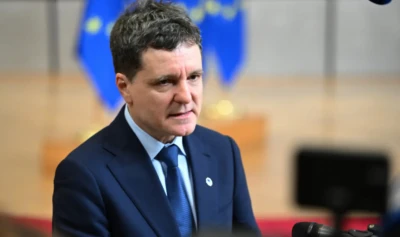


Romania is not the subject of the Preliminary Report of the Judiciary Committee of the US House of Representatives, and the references in the document to our country are "strictly contextual, in a much broader debate about freedom of expression", declared President Nicuşor Dan on Wednesday, in a Facebook post.
The head of state stated that the references to the 2024 presidential elections, presented in the report, "are strictly descriptive and only partially reflect the response of a single private company, the TikTok platform."
In this context, Nicusor Dan emphasized that these mentions do not represent and cannot substitute for a legal evaluation.
At the same time, the president stated that the cancellation of the elections was "an internal legal act to protect the constitutional order in the face of an asymmetric threat, based on the assessments of the national security institutions and on the authority of the Constitutional Court of Romania."
He recalled that the TikTok platform admitted, in several public reports, that it proactively identified several hidden influence networks, prevented and removed tens of thousands of fake accounts and interactions, and banned hundreds of accounts that imitated candidates in the presidential elections.
"Regardless of TikTok's technical conclusions cited in the report, the decision to cancel the elections was an internal legal act to protect the constitutional order in the face of an asymmetric threat, based on the assessments of national security institutions and the authority of the Constitutional Court of Romania," Nicusor Dan pointed out.


The President also stated that the Constitutional Court's decision was based on "documents that unequivocally indicated the distortion of equal opportunities between candidates and the massive tainting of the electoral campaign by a single candidate, through the non-transparent and illegal use of digital technologies and artificial intelligence, as well as through the undeclared financing of the electoral campaign, including in the online environment."
Nicusor Dan also evoked the Russian influence on the democratic process in Romania.
"The Russian Federation's interference in electoral processes in European countries, including Romania, has also been highlighted by official reports from NATO, the European Union and the British Government. The Russian Federation's malign interference was not limited to a single social media platform, but is the subject of a broad manipulation campaign aimed at destabilizing European democracies, an approach that has been taking place for many years in the form of a veritable hybrid war," the president stressed.
Nicusor Dan stated that Romania is a strong democracy, in which the decisions of responsible institutions, taken in accordance with the Constitution and the laws in force, are and must be respected.
"Romania's commitment to the rule of law, transparency, freedom of expression and the fairness of electoral processes remains unwavering, as does its commitment to all our allies and strategic partners," the head of state also highlighted.
The European Commission firmly denied on Tuesday that it had forced social networks to engage in "censorship", as claimed by a report presented by close associates of President Donald Trump in the US Congress, AFP reports.
This 160-page document, drafted by allies of the leader in the White House, accuses the European Union of having waged a "ten-year" campaign to control "what is said online" on a global scale.
These accusations are "absurd and completely unfounded", denounced a spokesman for the EU executive, Thomas Regnier.
In the sights of these American elected officials is the legal arsenal that Brussels has at its disposal to regulate the activity of large online platforms.
These European regulations are actually the strongest in the world. They are constantly criticized by the Trump administration and social media bosses, who believe that the regulations infringe on freedom of expression.
In this report, dubbed the "European censorship dossiers", the US Congress accuses the European Union of exerting pressure on online platforms to suppress publications criticizing COVID-19 vaccines.
He claims that Brussels has committed repeated "electoral interference" in the European elections.
"Freedom of expression is a fundamental right in Europe," a European Commission spokesperson stressed, accusing online platforms of "influencing voters" with their algorithms.





















Comentează