



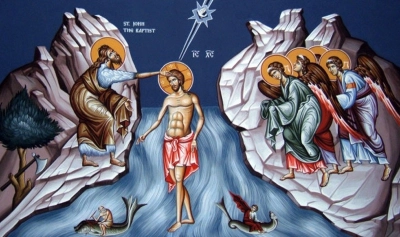


In the Orthodox Christian calendar, the winter holidays conclude with the feast of the Baptism of the Lord (Epiphany), an occasion which, in Banat villages, is marked by religious rituals and folk traditions that blend sacred meaning with community customs.
Ethnologist Maria Mandroane of the Banat Village Museum (MSB) in Timisoara says that, especially in villages in the Caras area of Banat, there is a custom for girls to go on the morning of Epiphany to a flowing body of water, wash their faces and then "speak" to the river, which on this day is transformed into "the pure water of the Jordan", asking it to fulfil their wishes.
"This ritual also has a very beautiful text called 'The River Jordan', through which the girl asks the river to help her and to love her. If the river is frozen, the girl removes the ice so that the flowing water may appear, and she speaks to it: 'Good morning, River of the Jordan.' - 'Thank you, pretty girl. Sit down, if you have come.' - 'I have not come to sit, I have come to wash my face, my arms, the apples of my cheeks, the bridge of my nose, to be radiant, as beautiful as the sun, pleasing to the world and dear to the land,'" Maria Mandroane explained to AGERPRES.
The ethnologist also notes that a series of customs foretelling the household's prosperity are linked to the priest's visit with the Iordanitul blessing to people's homes in Banat villages.
Thus, the priest must step into the house with his right foot and sit on a chair for a few moments, so that the girls may have suitors and the brooding hens may sit on their eggs.
"In our villages, the custom is preserved of placing basil taken from the priest's vessel with holy water under the threshold, so as to see one's destined spouse, or of placing a sprig of basil under the pillow to dream of him. On the morning of Epiphany it is said that the waters are very pure, and the holy water from the church must be kept throughout the year, as it has healing powers and protects the family from misfortune and illness. It is also good for the woman of the house to go at dawn to draw water from the well," Maria Mandroane said.

During this same period, the household feasts in Banat villages also come to an end. These began around the Feast of the Nativity of the Mother of God (8 September), and the last such feast is, according to the ethnologist, a kind of Chirelusa (Chiraleisa, popular, phonetic Romanian rendering of the Greek liturgical formula Kyrie eleison, namely "Lord, have mercy", editor's note), when the entire family, as well as the community, takes part in the meal.
The Protopope of Timisoara, Zaharia Peres, told AGERPRES that just as, at the feast of the Baptism of the Lord, the heavens are opened and the Voice of the Father is heard saying, "You are My beloved Son; in You I am well pleased", the same Voice will be heard on the day of the Transfiguration saying, "This is My beloved Son, in whom I am well pleased; listen to Him".
Father Zaharia Peres says that the holy water blessed at Epiphany has healing and protective powers against all evil. It is the moment of the year when every person in the world of the Banat villages who still follows tradition fills a bucket with the first pure water drawn from the household well, and ties a sprig of basil to the handle with a tricolour ribbon. The bucket is then taken to the church, where all the vessels are placed in the middle of the place of worship and the priest blesses them.






















Comentează