



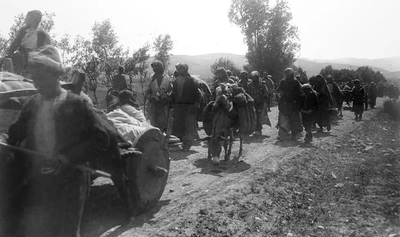


What is unique about the Romanian Holocaust is that very few Germans were involved, writer Gali Mir-Tibon said on Wednesday at the launch of her book The List of Mothers, hosted by the Embassy of the Federal Republic of Germany in Bucharest.
The List of Mothers is a historical novel about the tragedy of the deportations to Transnistria, combining rigorous archival research with literary sensitivity.
"The Germans were barely involved. The Holocaust in Romania was a Romanian creation, carried out in a Romanian way," the author added.
She said the horrors of the Second World War were acts committed "by people against people".
"Auschwitz was not another planet. The Holocaust was created by people, against people, and we must remember that. Perhaps human beings are the cruellest animals on the planet, and this is the proof. I believe that when you demonise people, you help the killers to murder them," Mir-Tibon said.
The author recalled that Jews were initially isolated in ghettos. "It is very hard to kill people who look like you. After a month or two in a ghetto, they look completely different, and then it becomes easier: 'They are not like us, they are different'. They were not. They were Romanians, and they were killed by Romanians, she added.
Mir-Tibon explained that her research for the book included the archives of the National Council for the Study of the Securitate Archives (CNSAS), which also contain post-war trials of those accused of crimes.
"I dwell on the word 'list', because the entire Holocaust was built around lists. Some were lists of those who were saved: in March 1944, a train carrying 1,500 orphans travelled from Transnistria to Iasi. My mother and her brother were two of those orphans. But there were other lists as well. All forced labour in Transnistria was based on lists. Who made those lists? In Transnistria it was called 'coordination'," the writer said.


Mir-Tibon said she had been taught at school that "the Holocaust was German", until survivors from Transnistria told her otherwise: "There were only Romanians. We did not see a single German." That moment set her on a path of further research.
"You Romanians are very brave to hear this, to read this. It is not easy for me to hear criticism of my own country, and I understand that criticism exists. Every country has its flaws. You are courageous, and I appreciate that. My mother would be overwhelmed to see me here, at the German Embassy, speaking with Romanians about what she lived through as a child. She would not believe it," the author said.
She also paid tribute to the Romanians who were recognised as Righteous Among the Nations for saving Jews during that period. "They are the heroes the younger generation of Romanians needs to know. I will never forget them," Mir-Tibon stressed.
Referring to the book, the German Ambassador to Romania, Angela Ganninger, showed the project began with a real list of Jewish deportees from a ghetto in Transnistria.
"To remember the victims means to restore their names, dignity and place in history. I believe that in her book Gali Mir-Tibon gives voice to Holocaust victims based on an authentic list from a Transnistrian ghetto, documenting Jewish women deported together with their children," Ambassador Ganninger said.
In turn, Israel's Ambassador to Romania, Dr Lior Ben Dor, noted that for many years the history of the Holocaust on Romanian territory had been ignored.
"The Romanian government made a very important decision, and since then Romania has assumed responsibility for what happened here, on this territory, against Jews during the Holocaust, crimes committed by Romanians," the diplomat said.
He also pointed out that Romanian teachers now teach the history of the Holocaust.
"The story you tell is important because it could be the story of any one of us. By understanding this, we recognise something more dangerous than any political ideology: the idea of 'the other', the belief that there are people who matter less, that we are less responsible for our neighbour for any reason linked to their being different. I believe we must stand together against the notion that a state should protect only part of its citizens rather than all of them," said Clara Volintiru, Secretary of State at the Ministry of Foreign Affairs (MAE).
The Romanian foreign ministry official stressed that "it is essential to understand that the state must protect every citizen on its territory and stand by them without discrimination, bias, or the false pretext of ideology".



















Comentează