



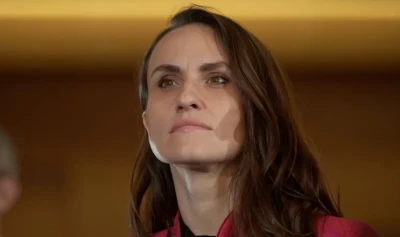


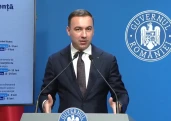
Romania supports the adoption by the European Union of the 20th package of sanctions against Russia, which in its war uses not only conventional weapons but also disinformation campaigns through which it seeks to weaken the EU, Romanian Foreign Minister Oana Toiu said on Monday ahead of the Foreign Affairs Council (FAC) meeting.
'Part of today's discussion concerns disinformation campaigns and how we manage the situation within the EU in order to create a common capacity to identify, prevent and combat these disinformation campaigns. Romania is a country that has been through such experiences and which at this moment sees inauthentic behaviour. It is very important to clarify that a lie told online millions of times represents a significant risk to European democracies and that Russia does not use only conventional weapons in its war, but in its strategy to destabilise the EU Moscow uses disinformation campaigns through which it tries to weaken the European Union. Romanians have shown this resilience, but we cannot take that as a solution that does not require institutional support, I am referring to increasing society's resilience,' Minister Oana Toiu said in response to a question from AGERPRES.
She underlined the importance of increasing investment in connecting the energy network, both in the context in which Moscow uses energy as a weapon and in the perspective of Ukraine's future post-war reconstruction plan.
'What we have seen in the four years of unprovoked war of aggression is not only a war that Russia has started against its trade, but also a Russia that is against its own citizens, sending them to their deaths or now having more than one million Russian citizens wounded in hospitals. We see a Russia that is making decisions against its own citizens, a Russia where citizens' freedom of expression and all the things we enjoy in our democracy are being curtailed. That is why today we will discuss something that is very important on the European continent - how we recognise and what we do to prevent malign interference, disinformation campaigns and hybrid attacks that are contrary to our democracies,' the head of Romanian diplomacy added.
According to her, it is necessary to increase international pressure on Russia, which 'must pay for what it has done.' In her view, adopting a new set of EU sanctions against Moscow is the correct strategy and the European Union must make sure that Russia does not increase its profits.
'Also, a demand from our citizens in every member state is that the burden be transferred onto the shoulders of the aggressors. Therefore, I am confident that this will lead us to the right decision. I am sure that this will happen in the coming days, that is certainly the objective, but each country currently has its own position. We have seen similar situations in the past and we have overcome them. That is why it is called the 20th package of sanctions. I am not sure when this will happen, but the EU will remain firm,' Minister Oana Toiu added ahead of the Foreign Affairs Council meeting, referring to the positions of certain member states on sanctions against Russia.

The foreign ministers of the European Union member states, meeting in Brussels on Monday, are trying to adopt the 20th package of EU sanctions against Russia, after the ambassadors of the member states failed last week to reach an agreement on the matter.
This objective, reaffirmed by EU High Representative for Foreign Affairs and Security Policy Kaja Kallas just before the FAC meeting, appears difficult to achieve on Monday after on Sunday Hungarian Foreign Minister Peter Szijjarto announced that his country would block a decision in this regard on the grounds that Ukraine had blocked the transit of Russian oil to Hungary through the Druzhba pipeline.
So far the EU has imposed 19 packages of individual and economic sanctions on Russia, as well as diplomatic measures and visa restrictions. The measures were designed to achieve the EU's policy objective of ending Russia's war of aggression against Ukraine by maximising pressure on Moscow and using all available instruments to reduce Russia's capacity to wage its illegal war of aggression.


















Comentează