



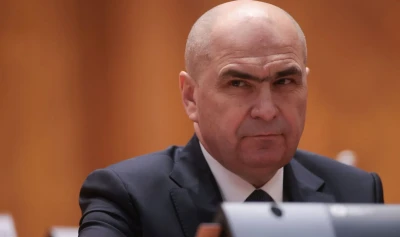


Prime Minister Ilie Bolojan said on Wednesday that there should be no statute of limitations for serious acts of corruption.
He noted, however, that such a measure should not be extended to less serious offences with no real relevance for society.
"The expiry of the statute of limitations for certain offences undoubtedly generates public dissatisfaction. We therefore need to see how such situations can be avoided. Another important aspect concerns the way judicial panels are formed, including appointments and secondments, so as to ensure stable panels that deliver rulings. I also believe it is important to examine why identical cases heard by different courts result in different sentences, in order to avoid such situations. Naturally, there are also issues related to magistrates' accountability and promotion within the justice system. (...) Without claiming to be a legal expert, I believe that, at least for serious corruption offences, there should be no statute of limitations," the prime minister told Digi FM.
Bolojan also warned that excessively long trials undermine the educational and social role of court rulings.
"The closer a sentence is delivered to the date on which the offence occurred, the stronger its educational role becomes, as social memory retains the connection. When three, five or seven years pass, people no longer remember why a sentence was handed down or what the case was about, because it has disappeared from social memory," he explained.
The prime minister recalled that a working group has been set up to analyse these issues and propose solutions, together with representatives of the Superior Council of Magistracy (CSM). The results are expected to be implemented either through a parliamentary initiative or a government-backed bill.
"Romanian citizens have low trust in two spheres: the political world, of which I am part, and the justice system. These aspects are confirmed by opinion polls and levels of institutional trust. This is a reality we cannot ignore, and each of us must consider what we can do to regain citizens' confidence," Bolojan said.


He added that, following legislative amendments adopted three to four years ago, institutional "interference" between politics and the justice system has been significantly reduced.
"From appointments to promotions, responsibility now lies entirely within the justice system. We must identify what has not functioned properly, and if it is found that issues cannot be resolved internally by specialists, based on existing experience, then external intervention becomes necessary. Such intervention can only take the form of legislative support," he said.
Asked whether he had considered dismissing Internal Affairs Minister Catalin Predoiu, who previously held the justice portfolio, Bolojan replied that Predoiu has delivered good results at the Ministry of Internal Affairs and played an important role in Romania's accession to the Schengen area.
"I cannot judge a minister who is currently responsible for a portfolio such as the Ministry of Internal Affairs, where I believe Mr Predoiu has achieved good results - and resolving the Schengen issue is to a large extent due to him - for the management of another system for which he has borne no responsibility for the past four years. (...) I assess ministers based on what they do during their current mandates. Overall, during this period, I have sought to encourage stability, rather than addressing image-related issues or responding to pressure. To achieve results in any system, one of the basic conditions - necessary, though not sufficient - is a certain degree of stability. If, every time something happens, in cases where responsibility is diffuse or unclear, we simply identify individuals to remove from office, we solve nothing," Ilie Bolojan added.























Comentează