



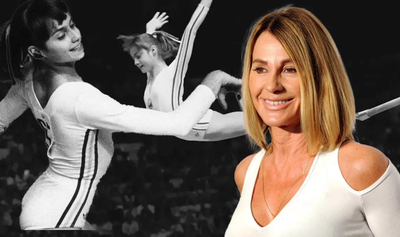


Shortly after Nadia Comaneci made history in Montreal by achieving the first perfect 10 in the history of world gymnastics, a plastic icon was born in Arad that would become one of the most coveted toys of the era. The Nadia doll, created in the renowned 'Aradeanca' plant, is today a rare collector's item, sold online for between 600 and 1,000 lei.
The story of the doll bearing the likeness of the legendary gymnast began with its first release in 1977. At the time, the toy was designed with a fringe identical to the one worn by the athlete, and was equipped with a tracksuit, a symbolic medal and presented in a customised box.
Years later, in 2009, in the context of a partnership with the 'Nadia Comaneci' Foundation, this symbol of Romanian sport was brought back to public attention through a special limited edition.
Octavian Fanata, the then director of the plant, who now owns the workshops where the tradition of doll-making continues, told AGERPRES that a much higher level of detail was sought for the second version.
'The second launch was in 2009, when we produced a new version of the Nadia doll. We created a special mould for the head, where the eyes had to be painted in order to reflect the character as accurately as possible. The 1977 doll had movable eyes, like most models, but this time we chose to paint the face and eyes. The clothing was similar, and the box was much more visually appealing,' Fanata explained.
The relaunched toy was delivered exclusively to the domestic market, and over the three years of the partnership more than 1,000 units were sold.
In the production halls in Arad, the manufacturing process has remained a form of manual art, unchanged for decades. Each doll passes through the hands of at least 10 employees. The process begins in the gelation workshop, where the head is cast, continues in the injection section for the hands, legs and body, followed by the meticulous stages of finishing, painting, hair sewing and assembly.


At the same time, the clothes are handmade.
An emblematic presence in the plant is Constanta Buzas, who has worked there for over 40 years and brought to life every Nadia doll in the 2009 edition. To achieve the perfect expression, she learned the technique of painting on plastic from an artist and used period photographs of the gymnast as reference.
'I was very fond of Nadia, I was a child, so you can imagine how delighted I was to work on the doll. The second edition of the doll passed entirely through my hands,' Constanta Buzas said.
Interest in this symbol remains alive today.
Recently, a personality from the world of sport requested 150 units from the plant to offer to pupils, but the order could not be fulfilled at short notice. Producing this quantity requires a production and delivery time of approximately three months.
The plant director points out that production of the Nadia model can be resumed at any time, as the mould has been preserved.
If it were produced today, this model would have a starting plant price of 200 lei, double than standard models, whose price at the plant gate does not exceed 95 lei.
Beyond the nostalgia of the 'Goddess of Montreal,' the Arad plant is a survivor of the economic transition. Established in 1949, it declined after 1989 due to massive imports of Chinese toys.
Although the brand went through critical moments, bankruptcy and liquidation, the activity was saved in 2008.
Today, the 'Aradeanca' plant and brand are owned by Octavian and Lavinia Fanata, and the business is a family one, sustained by 20 employees, a modest figure compared with the 1,200 of its golden age. The production capacity is 60,000 dolls per year, but garden decorations are also made here, such as gnomes, rabbits, owls and floating ducks.
The magic of the manufacturing process remains intact for younger generations, who visit the workshops as part of school programmes.
Manager Octavian Fanata underlines: 'Every year, during Green Week and Different Week, we have two or three groups a day of children from our county and neighbouring counties. The children follow the entire production process and are fascinated, because there is nowhere else they can see something like this. What interests them most is the oven, where they see how a soft paste takes the shape of the mould, such as a doll's head or a garden gnome. They are interested in dressing the doll, combing it, it is a dynamic activity.'
Although it is no longer in production, the Nadia doll remains the centrepiece of the Arad plant's exhibition, a silent witness to a time when Romanian toys captured children's hearts and honoured national champions.
The model can still be found in private collections, and online the 1977 doll sells for between 600 and 1,000 lei.






















Comentează