



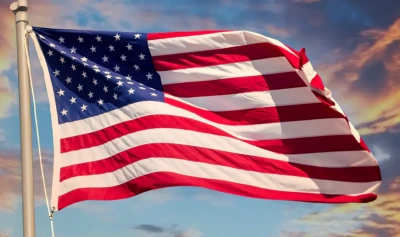


MAGA in the EU: Right-wing parties across the EU openly curry favour with the US leader. Where do Trump's biggest European supporters hail from and how are they aligning themselves with his values and the US administration's political line?
Lawmakers from Germany's right-wing Alternative for Germany (AfD) party made headlines in their home country last week when news emerged of them attending a gala hosted by the Republican Club, an important networking meeting of US President Donald Trump's party.
They are far from alone: politicians from many European nations openly admire the US president and his policies. Given his government's attacks on the European Union this is only at first glance a contradiction. These right-wing politicians feel often closer to Trump's authoritarian tendencies than to liberal or social-democrat movements at home.
Since President Trump's 2024 re-election, a core group of top-tier European politicians and major right-wing parties - especially from Hungary, Italy, the Netherlands, France, Germany, Spain, Austria, and Poland have publicly expressed support or admiration for Trump.
Trump's European cheerleaders have also joined forces in the European Parliament: In the Patriots for Europe grouping, Hungary's Fidesz party, France's National Rally (RN), Italy's Lega, Austria's Freedom Party (FPÖ), Belgium's Vlaaams Belang, Czechia's ANO, the Danish People's Party, Spain's VOX and the Dutch Party for Freedom (PVV) - among others - have positioned themselves as a pro-Trump faction in Parliament.

Mutual admiration society
The US conservative movement is prioritising contact with far-right European movements more overtly than in Trump's first term, said Nina Jankowicz, a specialist on disinformation who worked in the Department of Homeland Security under former President Joe Biden.
'We saw some of this kind of happening under the surface,' said Jankowicz, 'but now it's official policy.'
'I cannot think of a time when a US president was willing to just openly state his preferences in foreign elections in this way, at least in modern history,' said Thomas Carothers, director of the democracy, conflict and governance program at the Carnegie Endowment for International Peace.
Germany
High-ranking AfD members are regular guests at conservative events in the US. Party leader Alice Weidel herself did neither confirm nor deny that she planned a visit, only saying that she had received 'many invitations' from Washington which were currently being considered.
Trump's MAGA movement and the AfD share similar approaches to their migration and social policies, and both see themselves as fighting against what they perceive as left-wing hegemony in Western democracies. Trump's Vice President JD Vance and the president's former adviser, Tesla boss Elon Musk, had already taken sides with the AfD in the last German federal election campaign.
Vance had demonstratively met with Weidel on the sidelines of the Munich Security Conference earlier this year, where he accused Germany and other European allies of curtailing freedom of expression and marginalising parties such as the AfD.
France
Trump's MAGA (Make America Great Again) movement is cosying up to France's far right as part of his ideological offensive abroad since his return to office, with French authorities worried about its influence ahead of key elections.
The National Rally (RN) sees common ground with the US conservative movement. 'We can relate to topics such as the fight against immigration and border protection,' as well as denouncing 'woke' culture, said Louis Aliot, the vice president of the RN.
A poll in late November predicted RN leader Jordan Bardella would become president in 2027, whoever his opponent in the second round might be. While he is not the party's official candidate, the 30-year-old politician is very popular.
Marine Le Pen, who has vied for the position three times already, has been barred from running after a graft conviction. But she has appealed, with a retrial expected early next year.
Italy
The Italian government, led by Prime Minister Giorgia Meloni, maintains a pragmatic and ideologically aligned position withTrump, leveraging her personal relationship with him to act as a potential 'bridge-builder' between the US and EU.
Meloni was the only European leader who attended Trump's second inauguration in January 2025. Meloni's right-wing Fratelli d'Italia party shares many conservative views with Trump, including strict stances on migration, traditional family values, and opposition to 'woke' culture. However, Meloni has been critical of US tariffs on EU exports.
Hungary
Trump handed Hungarian Prime Minister Viktor Orbán a one-year exemption from sanctions for buying Russian oil and gas after the close right-wing allies held a chummy White House meeting in November.
The two right-wing populists have a lot in common politically. They hold similar positions, particularly on the subject of the war in Ukraine. Orbán has repeatedly praised Trump as a 'peace president' and is counting on him to end the conflict.
Trump meanwhile wholeheartedly backed Orbán on the issue of migration, saying that the Hungarian's EU counterparts should show him more respect.
Orbán visited his 'dear friend' Trump at his Mar-a-Lago residence in Florida three times last year, but the US president's return to power has had a mixed effect on Hungary. On one hand Washington has withdrawn sanctions against top Orbán aide Antal Rogan and restored the country's status in a visa waiver scheme. But on the other hand Trump's tariffs against the EU have hit Hungary's export-oriented car industry hard, contributing to an already weak economy.
Orbán faces an unprecedented challenge to his 15-year rule ahead of elections next spring amid economic stagnation. 'A very high percentage of European leaders would like to see Viktor Orbán lose the next election, but they're not going to say so out loud,' Carothers said.
Poland
Trump's homeland security chief, Kristi Noem, on a visit to Poland openly endorsed conservative President Karol Nawrocki already before being elected who went on to win the June election. Trump also showed his support for Nawrocki, who ran under the slogan which translates to 'Poland first! The Polish People first!'
When Nawrocki visited the White House in September, Trump said that he was proud to have endorsed him and congratulated him on winning the election. 'It was a pretty tough race, pretty nasty race, and he beat them all.'
Czech Republic
Incoming Czech premier Andrej Babi has more recently portrayed himself as a 'Trumpist and peacemonger' rejecting military aid to Ukraine. Babi is sympathetic to Trump's policies, but has criticised the US administration's tariff policy as 'crazy'.
The leader of the ANO movement was prime minister from 2017 to 2021 and in the October general elections returned to power. Babi's election slogan, 'Strong Czech Republic', is a direct reference to Trump's motto, 'Make America Great Again' or MAGA.
Foreign newspapers often portray the returning premier and billionaire as a 'Czech Trump', saying that he has a similar recipe for saving Europe - to oppose immigration and green policies.
Austria
Austria's right-wing FPÖ shares a lot of ideological ground with Trump on migration, sovereignty and scepticism against the EU. Party leader Herbert Kickl was one of the few European politicians invited to Trump's second inauguration, but did not attend. Kickl considers Trump as a role model.
According to a media report, the US government wants to remove Austria and three other countries from the EU. As reported by the platform 'Defense One', citing an alleged unpublished draft version of the new US security strategy, Austria, Hungary, Italy, and Poland are listed as countries with which the US 'should cooperate more (...) with the aim of pulling them away from the (European Union)'.
Netherlands
Geert Wilders, the leader of the populist Party for Freedom (PVV) is sometimes nicknamed the 'Dutch Trump' - and shares anti-immigration and anti-establishment views with the US president.
Spain
The Spanish right-wing party VOX sees eye-to-eye with Trump on a range of topics: border protection, Euroscepticism and conservative social values. Party leader Santiago Abascal hosted a 'Make Europe Great Again' event with other European right-wing leaders in Madrid.
But Trump's influence reaches further than just the right fringes of Europe:
Bulgaria
In December, Sofia became the first EU member state to hold a Strategic Dialogue with the US under the new administration.
In late November, several political leaders publicly commented on President Trump's efforts to end the war in Ukraine. Former prime minister Boyko Borissov welcomed the US peace initiative, describing it as a basis for further work, while stressing the importance of coordination within the EU and NATO and continued support for Ukraine.
President Rumen Radev described Trump's peace plan as 'rational', and warned that Europe risks prolonging the conflict by delaying negotiations, and criticised continued financial and military support for Ukraine.
Slovenia
In Slovenia, the homeland of US First Lady Melania Trump, there is no party that openly and directly imitates Trump's policies.
The most overlap can be seen with the largest opposition party, the SDS. Its president and former prime minister Janez Jana, who hopes to return to power following the elections in spring 2026, belongs to the circle of like-minded people around Orbán. The SDS advocates a tougher policy on migration, the protection of national borders, and regularly attacks the media, the judiciary and LGBTQ+ rights.
The content of this article is based on reporting by AFP, APA, BTA, CTK, dpa, STA, as part of the European Newsroom (enr) project.










Comentează