



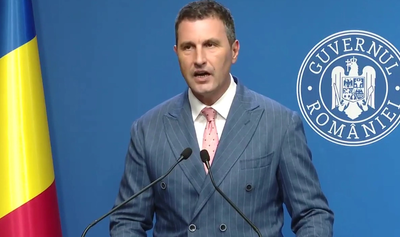


The budget outlook for 2026 is "significantly better" than a year ago, Deputy Prime Minister Tanczos Barna told AGERPRES on Thursday, as preparations begin for drafting the state budget law, pointing out that the priority this year remains the absorption of the National Recovery and Resilience Plan (PNRR) funds.
Tanczos Barna said that a first discussion took place at the Government on Wednesday with representatives of local authorities regarding the allocation and balancing of amounts reaching local budgets, namely income tax and VAT, agerpres reports.
The talks also covered additional revenue resulting from the increase of local taxes.
"As a first conclusion, local authority representatives continue to adhere to the principle implemented for years, namely that income tax should remain 100 percent a source of revenue for local authorities," Tanczos Barna said.
He pointed out that local authorities' concern that additional income tax revenue would go to the state budget is unjustified.
"The main concern [of local authorities] was that additional income tax revenue would not reach the state budget. This is not a justified concern, as these amounts remain in the budgets of local authorities. The allocation and balancing formulas are what will ensure a fair distribution of funds," the Deputy Prime Minister said.
According to him, the analysis of the 2025 budget execution shows that the new calculation formula and balancing mechanism, based on the solidarity fund extended nationally, have produced positive results both for the state budget and for local authorities.

Tanczos Barna mentioned that the Government intends to maintain the same principles in 2026, in order to achieve savings for the national budget and to ensure sufficient resources for the functioning and development of local administrations.
"We want to continue the same principles in 2026, so that we can achieve savings for the national budget and also ensure sufficient funds for the functioning and development of local authorities, given that there are very many projects underway, many PNRR and European funds projects, which require considerable co-financing amounts and we cannot risk the absorption of European funds even in 2026," Tanczos Barna said.
He mentioned that, in the coming period, the Ministry of Finance will prepare simulations for the 2026 budget, followed by further consultations with representatives of local administration organisations.
Regarding the parliamentary procedure for the 2026 budget, the Deputy Prime Minister said it will begin in mid-February, with the final vote expected at the end of February.
According to Deputy PM Tanczos Barna, the budget outlook is "significantly better" than a year ago.
"The outlooks are significantly better than one year ago. The 2025 budget execution shows that, based on the example of a few ministries that managed to reduce operating expenses, including personnel costs, this is a solution for the Government - reducing bureaucracy, cutting personnel costs at the national level, which in turn eases pressure on the budget and provides the possibility of a gradual reduction of the budget deficit," the Deputy PM said.
He underscored that the absolute priority for 2026 remains the absorption of the PNRR funds and cohesion funds, as well as the implementation of reforms in central and local administration.
"We still face a major challenge for 2026, the absorption of PNRR funds, and all institutions must focus on this, so that by the end of August the programme is implemented, the funds are spent, projects are completed and reforms are carried out. It is the number one priority for 2026. At the same time, we must allocate sufficient funds to ensure the absorption of European funds in 2026 for cohesion funds and account for the budgetary impact of reforms in local and central administration," the Deputy Prime Minister added.
He expressed his hope that next week the procedure for assuming responsibility on the package regarding local and central administration reform will begin.
According to the Deputy PM, on Thursday morning a new discussion took place at the Ministry of Finance regarding the economic recovery package, "so that this package can also be finalised and, in parallel with the administration reform package, it can be approved and we can move forward with that instrument for generating economic growth and private investment in Romania, starting in 2026."
Tanczos Barna brought to mind that one year ago Romania faced the risk of being downgraded to "junk" status by rating agencies and the danger of European funds being suspended in the absence of substantial reforms.

















Comentează