



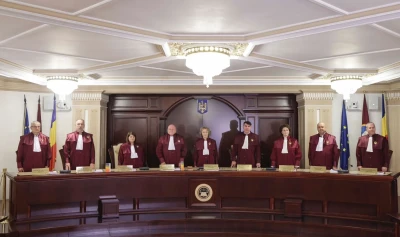


The Constitutional Court of Romania (CCR) resumes on Monday, starting at 10:00, the debates on the referral filed by the High Court of Cassation and Justice (ICCJ) regarding the new draft law of the Bolojan Government on the reform of magistrates' pensions, Agerpres reports.
The ruling in this case has been postponed twice, most recently on Sunday, because of a lack of quorum, after some judges left the room during the hearing and did not return.
The new draft amending magistrates' pensions, adopted by the Government provides for a phased increase in the retirement age to 65. The amount of the pension may not exceed 70 percent of the net allowance received in the final month of activity.
The draft received a negative opinion from the Superior Council of Magistracy (CSM). Judges and prosecutors requested that their pension be close to the level of the last salary received, while Prime Minister Ilie Bolojan insisted that the pension should not be higher than 70 percent of the last net salary received.
The first draft of the magistrates' pensions reform was declared unconstitutional by the CCR on 20 October, following a referral filed by the High Court of Cassation and Justice. At the time, the CCR argued that the Government had failed to request, within the timeframe set by law, an opinion from the CSM, even though it is consultative.
Judges of the Supreme Court decided at the beginning of December, by a unanimous vote, to refer the Constitutional Court regarding the new draft law.
Magistrates were convened by the president of the ICCJ, Lia Savonea, to express their standpoint, within the United Sections, regarding the new draft law on special pensions from which judges and prosecutors are to benefit.


All 102 judges present at the meeting voted in favour of referring the matter to the Constitutional Court of Romania.
According to a release of the Supreme Court, the law discriminates against magistrates compared with other categories of service pension beneficiaries; brutally undermines the independence of justice; effectively eliminates the service pension for magistrates; breaches international standards established by the case law of the Court of Justice of the European Union (CJEU) and the European Court of Human Rights (ECHR); fails to observe the binding nature of the Constitutional Court rulings; uses ambiguous and unclear terms and contains regulatory gaps that make the law incompatible with the standard of clarity and predictability in a state governed by the rule of law.
Moreover, judges argue that the challenged law creates a disadvantageous and discriminatory legal regime for magistrates regarding their right to a pension, compared with professional categories in similar or analogous situations (other beneficiaries of service pensions).
In addition, they maintain that the explanatory memorandum accompanying the draft law contains no figures-based justification regarding the financial impact of the new regulation.
"Within the service pensions system, out of a total of more than 200,000 service pension beneficiaries, 90 percent belong to the defence and public order system (approximately 190,000 people, military personnel, police officers, SRI [the Romanian Intelligence Service], SIE [the Foreign Intelligence Service], SPP [the Protection and Guard Service] officers, civil servants with special status, gendarmes etc.), while more than 10,000 belong to other professional categories (magistrates, clerks, parliamentary civil servants, members of Romania's diplomatic and consular corps, civilian flight crew and staff of the Court of Accounts). For the payment of entitlements for all categories of service pension beneficiaries (including magistrates, but excluding those in the defence and public order system), the required budget amounted to 2.2 billion lei. The total budget allocated for the payment of military pensions in 2024 exceeded 14 billion lei. The largest share of this amount is allocated by the MAI [the Ministry of Internal Affairs], with a budget of more than 7.36 billion lei, followed by the MApN [the Ministry of National Defence] with more than 5.5 billion lei and the SRI with more than 1.08 billion lei. The explanatory memorandum is intended rather for public communication of an untrue narrative than for the official and rigorous substantiation of the need to amend the legal framework solely with regard to magistrates," the High Court of Cassation and Justice said.






























Comentează