



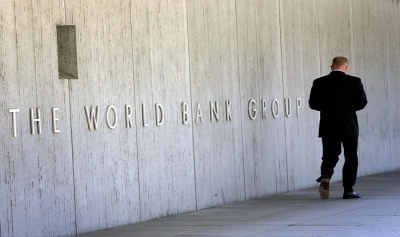
The Romanian economy will record a 3.5% advance in 2019 and an advance of 3.1% in 2020, down one percentage point from the June 2018 forecast, according to the semiannual "Global Economic Prospects," published on Wednesday by the World Bank (BM).
Also, the international financial institution expects Romania to report for the year 2018 an increase of 4.1% in GDP, which is again down one percentage point from the June forecast.
The expansion is expected to ease in 2021, when Romania's economy will see an advance of 2.8%, the World Bank report said.
The international financial institution estimates that in Europe and Central Asia (ECA), a region including Romania, the economy slowed down to 3.1% in 2018, from 4% in 2017, reflecting the decline in Turkey's economic activity in the second half of last year.
Leaving Turkey aside, the regional growth remains unchanged at 2.9% in 2018, as slowing economic activity in countries like Bulgaria and Romania was offset by accelerated dynamics in the eastern part of this region, which benefited last year from the higher price for crude, according to the WB.
The Central European countries recorded a slower GDP growth in 2018. The weakening of exports and the lack of work force affected the growth in Bulgaria, Croatia and Romania. In contrast, despite the lack of employees in Poland, the economy of this country has accelerated slightly due to the solid level of consumption and investments.
The tax policy in the region has varied significantly, according to the World Bank report. Turkey committed to strengthen its monetary policy in order to curb inflation and stop the depreciation of its currency. In Romania, the cut operated in the income tax and the salary increases in the public sector have offset an increase in social contributions, which recorded the first surplus last year since 2012.
In most countries in Europe and Central Asia, the monetary policy is stable or relaxed. At the end of 2018, nine countries had lower interest rates than one year ago, while three other states increased their monetary policy interest rates: Romania, Ukraine and Turkey.
In Central Europe, work force shortages and the rising energy prices have led to a rising inflation, but the monetary policy stayed stable in most countries. An exception was Romania, where robust domestic demand resulted caused the upper limit of the inflation targeting to be exceeded, determining thus the strengthening of the monetary policy, according to the "Global Economic Prospects" report.
World Bank downgrades estimates for Romania's economic development in 2019 and 2020
Sursă foto: stiripesurse.ro
Distribuie articolul


Distribuie articolul

Explorează subiectul

București 8°C
8°C
8°CArticole Similare

16
After visiting 85 countries, two Americans settled in Sibiu, drawn by its 'peace and warm people'
16

4
Gov't approves draft on 500-million-euro EIB loan for Sibiu-Pitesti motorway construction
4

3
Gov't updates methodological norms regarding the implementation of international development cooperation, humanitarian assistance activities
3

9
JusMin Marinescu: We are making efforts to obtain funding for electronic monitoring bracelets for inmates
9

8
Gov't approves agreement with R. Moldova on coordinated border control
8

53
President Nicusor Dan receives Ukrainian president Volodymyr Zelensky with military honours
53

17
Hungary's President to visit Targu Secuiesc on Sunday for Day of Hungarians Worldwide
17

11
Bucharest University to kick off 'Science on an open stage' conference series
11
14
Digital Innovation Summit 2026/Energy Minister Ivan: The future belongs to technology, which needs energy
14

5
PM Bolojan says public funds can no longer be directed into "spinning" mechanisms
5

13
CFR SA: Modernisation works begin on Bucharest Progresu-Jilava-Giurgiu Nord Frontiera railway line
13

16
Diesel price could reach 9.8 per litre in the next two weeks (expert)
16

11
Romania-Italy Cultural Year/Author Catalin Pavel invited to 'The Month of Romanian Literature in Rome'
11
















Comentează