



Almost a third (1.7 million) of the 3.6 million Syrian refugees officially registered at this point in Turkey are children, more than 500,000 of them receiving support to integrate with the national educational system in this country, under the PIKTE (Promoting the Integration of Syrian Children into the Turkish Education System) programme, according to data provided by the Turkey-based Directorate General for Migration Management - DGMM in October 2019.
The programme is among the largest carried out under the umbrella of the EU Facility for Refugees in Turkey initiated in 2015. It is based on an agreement concluded between the Brussels authorities and the Ankara authorities, which establishes education as a priority field in the complex process of integration of the newcomers into the Turkish society.
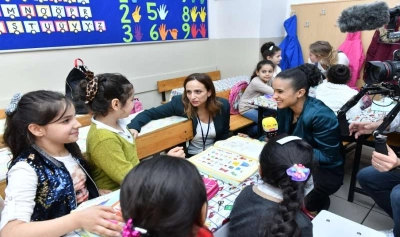
Under this programme, most Syrian children were transferred from the temporary educational centres to the normal schools in the Turkish education system, according to the statement made by the coordinator of the PIKTE project, Pinar Özel, during a visit paid to a neighborhood school in Istanbul, organised by the EU Delegation to Turkey, for journalists from several member states.
However, the process by which these children were transferred from the temporary centres to the schools in the public education system was far from easy, in the context in which there was not enough space in the schools to receive all the children and the authorities needed to enlarge the existing infrastructure first, by building new schools or extending the ones already running. They also needed to hire additional personnel after extending the infrastructure, like additional janitors, considering that the number of children per class increased, and also additional security staff, as the tensions in school also increased. In some schools the number of Syrian children was even higher than the number of Turkish children, wherefrom the tensions.
Also, the fact that the Syrian children did not know the Turkish language represented another major problem the authorities needed to deal with, by hiring no less than 4,500 teachers to help the Syrian children with their Turkish language acquisition.
Besides all these, 40,000 Syrian pupils benefit from free transport, school materials and other benefits.
Some other programmes, in addition to this, are designed especially for teachers who, besides teaching their respective subjects, also need to help the children develop a certain sense of belonging to the Turkish society. According to the coordinator of the PIKTE project, several studies were conducted at academic level to asses how things were done so far and is still to be improved, in terms of the integration of the Syrian children with the Turkish education system.
Given all the above and the complexity of the situation, the Ministry of National Education of the Republic of Turkey said that, although the help from the EU is substantial and very much needed, it is not enough, with the Turkish authorities contribution also being quite significant.
At the same time with the restructuring of schools in the Turkish public education system, to welcome the Syrian pupils, the Turkish and European partners also developed a system of teaching Turkish language to the adults, under the United National Development Programme - UNDP, called the Turkey Resilience Project in Response to Syria Crisis - TRP, financed via the European Union Regional Trust Fund (EUTF).
The project is meant to help with such critical needs of the refugees as their need to enter the Turkish labour market.
According to the figures provided by the coordinators of this project, 70 per cent of those who attend these language courses are women, who want to be able, first of all, to communicate with their children's teachers, with the doctors, if needed and, in general, with the Turkish authorities.
However, while the Syrian women need to learn Turkish language mainly to know their way around in the Turkish society, for the men the main reason for which they want to learn Turkish is to be able to find a job easier in Turkey, where the labour market is already affected by the war going on in the neighbouring country.
In fact, the lack of education in general makes the Syrian refugees become easy targets for the various extremist organisations always in search of new recruits, as the head of the European Union Delegation to Turkey, Ambassador Christian Berger explained during a meeting with journalists that took place on November 15 in Istanbul. Therefore, education remains one of the main fields in which the Turkish authorities and their European partners invest their efforts in managing the situation of the refugees in Turkey.
Starting with 2015, the European Union and the member states got actively involved in the process of integration of the largest wave of refugees in history, which stormed Turkey, after the war started in the neighbouring country, Syria, through the EU Facility for Refugees in Turkey - FRIT. The established amount was 6 billion euro, which money was divided into two tranches of 3 billion euros each and managed together with the relevant institutional partners in Turkey, certain UN organisations, NGOs or international financial institutions, within no less than 95 projects carried out in several fields of activity.
In more exact terms, only the first tranche was entirely committed until now, while for the second tranche the Turkish authorities and EU partners are now in the stage of trying to identify the local partners, who will actually implement the projects.
Moreover, in the meantime, EU restarted the negotiations with the Member States to prolong the financial aid granted to Turkey, which country, due to its geographical position, continues to receive new refugees, and not just Syrians, according to the statement made by Ambassador Christian Berger at the meeting with journalists in Istanbul, on November 15.
Turkish national education system struggles to integrate children of Syrian refugees
Sursă foto: Agerpres
Distribuie articolul


Distribuie articolul

Explorează subiectul

București 4°C
4°C
4°CArticole Similare
9
Romania's beekeeping sector struggling after major bee colony losses and declining honey production
9

10
Tulcea County residents receive new message of extreme alert, amid war in Ukraine
10

6
Bucharest Stock Exchange closes lower on most indices in Friday's trading session
6
6
Senate Speaker Abrudean says budget is key to continuing started reforms
6
8
Her Majesty Margareta meets new US Ambassador Nirenberg; talks focus on Romania-US cooperation
8

16
Over 7,400 Romanians - registered for European civil servants; free training sessions (ForMin Toiu)
16
9
Romania provides support to Republic of Moldova over pollution on Dniester River; intervention team arrives in area
9
7
DefMin Miruta meets new U.S. ambassador: Romania is firm promoter of strengthening transatlantic relationship
7

6
First edition of "Robotics for Good: Youth Challenge" in Romania to take place on Sunday in Ramnicu Valcea
6
6
AgriMin Barbu calls on Competition Council to investigate mark-ups along route between farmers and consumers
6
7
PM Bolojan says interconnection of energy networks with neighbouring countries is important in times of crisis
7
10
Budget Committee meetings discussing the 2026 budget will be exclusively in person
10

7
Parliament: 2026 draft budget to be submitted for final vote on Thursday
7











Comentează