



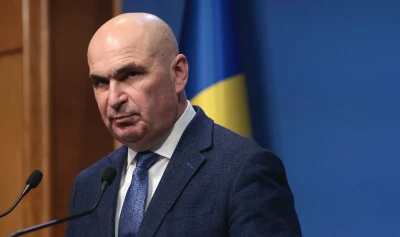


The so-called "smart operators" have largely blocked Romania's energy system through speculative investments, Prime Minister Ilie Bolojan said on Friday, stressing the need to amend regulations to prevent such practices.
"We have done many things improperly in recent years. Romania currently produces around 9,000 MW, which broadly reflects the balance between energy production and consumption. However, in order to connect to the energy system as a producer or storage operator, technical grid connection permits (ATRs) have been issued for 77,000 MW. In practice, this means we have occupied the entire realistic grid connection capacity for energy investments. If tomorrow you want to build a storage facility in Romania, you cannot connect, because all capacity is taken. Some of these projects belong to serious investors, but most are speculative ventures by so-called 'smart operators'. If you want to connect a project today, you have to buy the paperwork from them," Bolojan said on Europa FM radio.
According to the prime minister, corrective measures are needed, although they will not be easy to implement.
"These are not easy steps, because for years these ATRs were issued without any conditions - no guarantees and no obligation to actually carry out the investment. This must be corrected. Once this grid capacity is freed up, serious companies that genuinely want to invest in energy will be able to implement projects, increasing capacity by 2,000 to 3,000 MW. We will then be able to boost production and reduce prices, so that energy is available at an acceptable cost. In essence, speculative operators have largely blocked the energy system simply by holding permits and occupying grid capacity," Bolojan explained.
Asked about the target for reducing energy prices, the prime minister said: "If we increase production and, above all, storage capacity, we can lower energy prices in the coming years. However, this requires an additional 1,000 to 2,000 MW of storage capacity. In my view, if we take these steps, electricity prices will show a downward trend. I do not think it appropriate to provide absolute figures, but prices could fall by 10 to 20%, provided we do what is necessary free up grid capacity and allow those who genuinely wish to invest in energy to do so. For this to happen, state-owned companies must act on economic principles, and the regulatory authority must amend the regulations to prevent such situations. When all grid capacity is occupied, investors are effectively forced to pass through an internal 'customs checkpoint' in order to proceed with an investment, which is unfair to investors, to the economy and to citizens."



















Comentează