



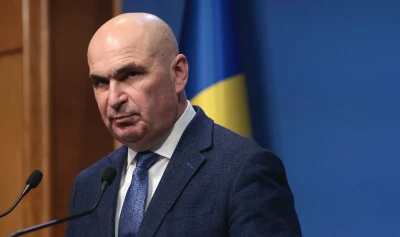


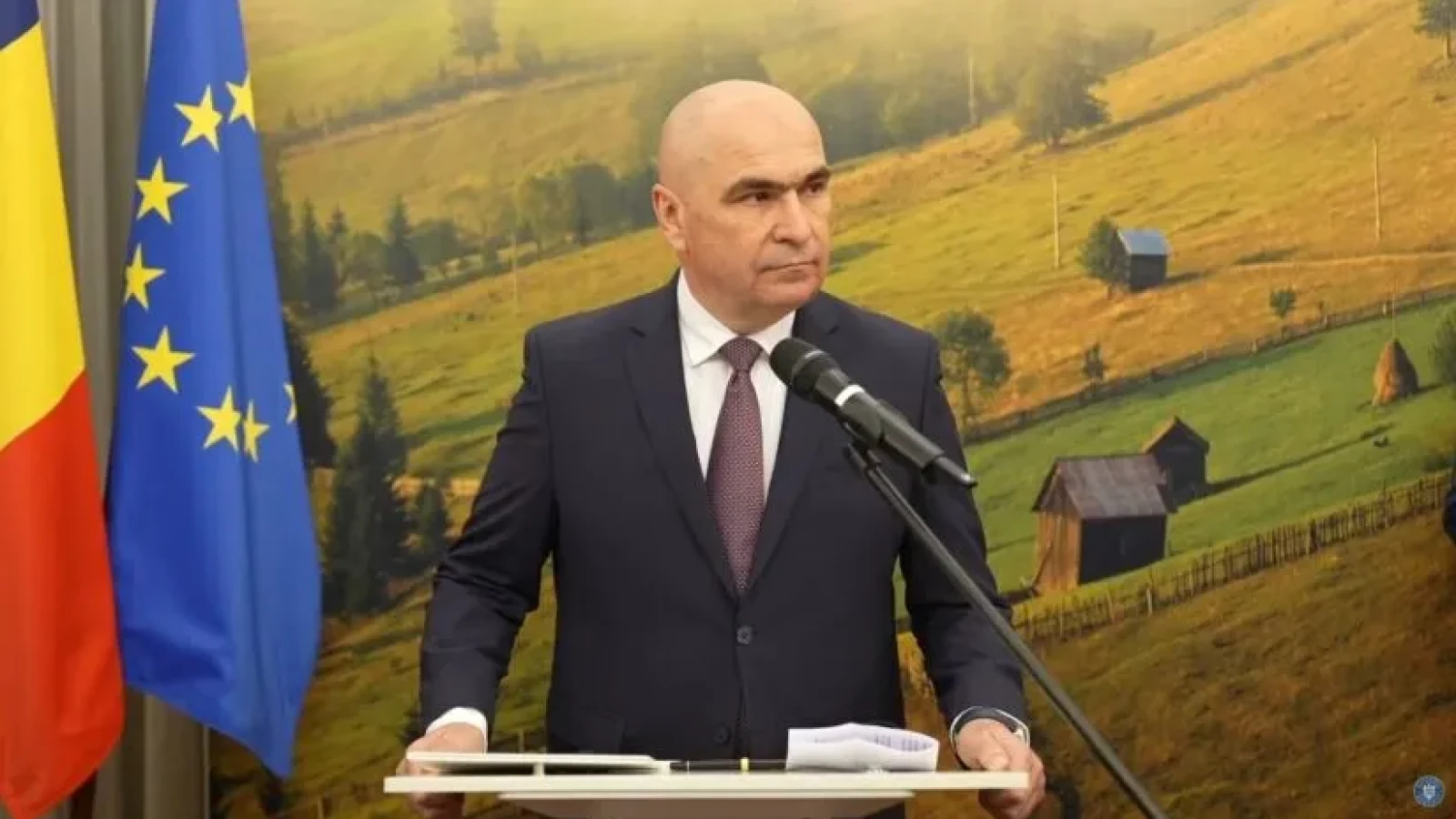
Prime Minister Ilie Bolojan says that the temporary technical recession in Romania is part of the anticipated cost of the transition to a solid economy.
Romania is not going through "a crisis", but a period of economic correction "necessary to have a more stable and stronger economy," Bolojan wrote in a social media post on Friday.
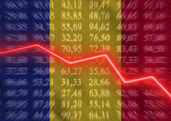
The statements were made as data published by the National Institute of Statistics show Romania's economy grew by 0.6% in 2025, but ended the year on technical recession, after the Gross Domestic Product (GDP) decreased by 1.9% in the fourth quarter from the third quarter of 2025. That was the second consecutive quarter of decline.
"Romania's economic growth in 2025 was 0.6%, given the rapid change, in only 6 months, of the economic model that led us with our backs to the wall. We began the transition from a model based on deficit and consumption, apparently generating prosperity, but in fact destructive, to a model based on investment, productivity, exports and budgetary discipline. The temporary technical recession is part of the anticipated and inevitable cost of this transition, which will ultimately lead us to a solid economy, healthy growth and real prosperity, based on what we produce, not through more and more expensive loans," Bolojan said.
He compared the years 2024 and 2025, noting that in 2024 there was a "high" budget deficit of almost 8-9% of GDP. There was also a "significant" external deficit of 8.2% of GDP, but with a "modest" real economic growth, below 1%.
"Normally, such a fiscal stimulus should have generated much stronger growth. That did not happen. Moreover, in the first part of 2024 there was, according to INS, a technical recession, with decreases of 0.4% in the first two quarters of the year. Why? Because an important part of the money spent in 2024 was geared towards current consumption, rigid spending and the compensation of social and inflationary pressures, not towards the real development of the economy," Bolojan said.


According to him, strong consumption in 2024 came from "more and more" imports, and high inflation absorbed an important part of that strong fiscal impulse.
"In other words, in 2024 we spent a lot, but we grew a little. It seemed that the situation was favourable, but the economic imbalances were deepening."
On the other hand, in July 2025, the context changed "fundamentally", as the recovery began.
"We achieved a correction of about 1% of GDP, a significant effort that generated social costs and dissatisfaction. I wish there was a way to avoid them. Theoretically, such an adjustment should have generated a sharp slowdown in the economy. However, the data show that, in 2025, economic growth remains around 0.6%."
Thus, in 2024 there was a large fiscal stimulus, with little economic impact and with the accumulation of internal and external imbalances. In 2025, fiscal discipline measures were taken, but a similar growth was recorded, "supported by real investments and structural factors."
"That shows that the fundamental problem was not the lack of money, but the way it was used. But fiscal consolidation is not an end in itself. It is an essential condition for stability, credibility and sustainable development. Transition temporarily implies a period of economic contraction. It is a necessary cost to build a more solid and competitive economy. We are not going through a crisis. We are going through a period of economic correction necessary to have a more stable and stronger economy, which will bring long-term prosperity."


















Comentează