



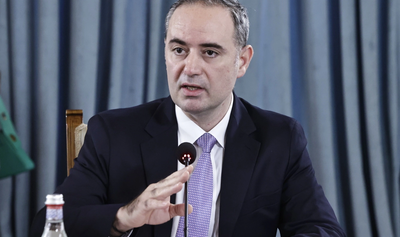


The emergency ordinance regulating a set of measures necessary in preparation of the 2026 budget, as well as a series of strategic measures for the following year, was published on Monday evening on the website of the Ministry of Finance.
"For 2026, we are coming up with a package of measures agreed by the governing coalition, starting from concrete things: lower taxes and simpler rules for the business environment, financial support for low-salary employees, less bureaucracy in relations with the state, stricter rules on spending public money and firm measures to combat tax evasion. Thus, we aim to create a more stable and predictable fiscal framework for the business environment, which will stimulate investment and economic development. At the same time, we protect the purchasing power of vulnerable employees, reduce social pressures generated by inflation and increase the efficiency and transparency of the use of public funds, including at the level of state-owned companies, contributing to maintaining macroeconomic balances to the benefit of the entire economy and Romanian society," Finance Minister Alexandru Nazare stated, as quoted in a press release of the Ministry of Finance.
The project also includes measures for local public authorities, in order to support them in implementing projects from the PNRR (National Recovery and Resilience Plan) with deadlines this year, as well as to support them during the winter, providing them with the possibility of contracting loans from the treasury.
The measures to reduce budgetary expenditures include reducing subsidies for political parties and amounts granted to minorities, reducing the lump sums that parliamentarians benefit from in 2026, postponing the application of measures that would have generated additional increases in budgetary spending in health and social assistance. Also, indexation mechanisms are modified to ensure budgetary sustainability, through prudent updates of some categories of rights and services, and stricter rules for expenditure control and financial responsibility at the level of public enterprises are introduced, Agerpres informs.
On the other hand, the measures to revive the economy, stimulate private investment and simplify matters for taxpayers aim to: reduce the minimum turnover tax (IMCA) to 0.5% in 2026 for all taxpayers and eliminate it in 2027; apply a flat rate of 1% to the income tax for micro-enterprises, regardless of income or type of activity; eliminate the construction tax ("pillar tax"), starting with 2027; consolidate fiscal digitalisation by expanding and clarifying the use of RO e-Invoice; simplify RO e-VAT mechanisms, respectively reduce administrative burdens, through more efficient and better targeted fiscal control.


In order to support vulnerable people, the draft GEO proposes support for employees with the minimum salary, extending the non-taxation of a part of the salary, to increase the net income of people with low incomes, protection for vulnerable energy consumers, social support measures being extended until December 31, 2026, with fairer rules for determining eligibility, to ensure the continuity of aid and combat energy poverty, the continuation of the "Healthy Meal" programme, students in pre-university education, (...) and improving the financing of social services, creating the legal basis for updating the daily food allowance in social assistance institutions, for a more realistic budget and quality services in 2026.
Regarding the fight against tax evasion and modifications to the regulations in the field of excise products, the draft normative act provides that the authorisation of operators in the field of excise products is centralised at the level of ANAF (National Agency for Fiscal Administration) and is based on on the assessment of the financial credibility of administrators, associates and the source of funds. Also, extended financial guarantees are introduced for importers and distributors of energy products, which effectively cover the risk of non-payment of VAT and excise duties, the authorisation, reporting and control regime for operations with energy products is tightened to ensure full traceability of transactions, transaction chains are shortened by limiting intermediaries without authorised storage capacities.
The project also includes other categories of measures necessary until the approval of the budget, such as: measures aimed at budgetary regulations necessary for local authorities and essential public services at the beginning of 2026, through transitional rules for the distribution of income tax, to ensure balancing amounts, until the approval of budgets; measures related to the framework for the approval of revenue and expenditure budgets, as well as the salary policy at the level of public enterprises, for the year 2026; transitional measure for the continuity of the activity of autonomous institutions under parliamentary control, fully financed from their own revenues, which do not have an approved budget at the beginning of the year, may temporarily operate based on a "1/12" type mechanism, making monthly expenditures and commitments within the limit of one twelfth of the execution of 2025, until the approval of the 2026 budget.






















Comentează