



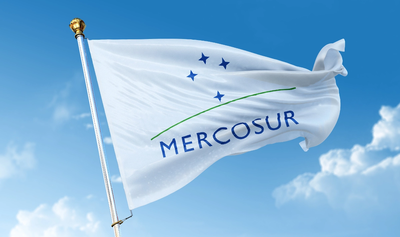


After 25 years of negotiations and amid turbulent global tensions, the EU is set to formally sign a landmark trade agreement with four South American countries. However, back home farmers' fury is mounting and some member states are already gearing up to block the Mercosur vote in the European Parliament.
A majority of European Union countries gave the go-ahead on Friday for the bloc to sign the Mercosur free trade deal with Brazil, Argentina, Uruguay and Paraguay after decades of negotiations and a last-minute postponement just before Christmas.
During the meeting of EU member state ambassadors in Brussels, five governments opposed the agreement - France, Poland, Austria, Hungary and Ireland -, while Belgium abstained. The previous stalemate back in December was broken with the 'yes' of Italy, which, after receiving final guarantees, resolved its reservations.
Therefore, on Saturday, January 17, European Commission President Ursula von der Leyen and European Council President António Costa are to travel to Paraguay's capital Asunción - since the country is currently holding the rotating Mercosur presidency - to formally sign the treaty.
According to the Commission President, this step establishes Europe as a "reliable partner", able to "chart its own course". Von der Leyen also stated that "today Europe has sent a strong signal that we are serious about (...) our commitment to diversify our trade and reduce our dependencies".
The agreement was also welcomed in South America, with Brazilian President Luiz Inácio Lula da Silva calling it an historic day for multilateralism. "Against the backdrop of an increasingly protectionist and unilateral international environment, the agreement is a signal for international trade as a factor for economic growth, from which both blocs will profit," he said.
However, the deal still has to be approved by a majority of MEPs in the European Parliament, where voting coalitions have become more volatile and unpredictable. A date has not yet been announced. Farmers remain strongly opposed, with groups such as the Irish Farmers' Association saying they were working on torpedoing the agreement in parliament.
If ratified, the new free trade zone, with more than 700 million inhabitants, would be the largest of its kind in the world, according to the European Commission. It is estimated that the agreement could increase annual EU exports to Mercosur countries by up to 39 percent, or 49 billion Euro, which could support more than 440,000 jobs across Europe.
Mercosur's heavyweight backers
Last year, the EU's trade dispute with the United States brought new momentum to the stalled process, with European countries wanting to demonstrate that fair trade is not a thing of the past.
German industry had been pushing for years for the deal to be concluded. German Chancellor Friedrich Merz welcomed Friday's breakthrough as a "milestone in European trade policy and an important signal of our strategic sovereignty and ability to act".
In particular, the automotive industry, mechanical engineering and the pharmaceutical sector stand to benefit. Car imports to Mercosur countries are currently subject to a 35 percent tariff, for example.
Deloitte economist David Marek said this was an important moment at a time when markets are focusing more on protecting the domestic market from foreign competition. Within the European market, competition would also increase, which could lead to efforts to reduce product prices and improve their quality.
According to XTB investment platform analyst Pavel Peterka, Czechia is one of the biggest winners of this agreement, whose automotive sector, like Germany, will benefit greatly.
Spain is one of the countries which pushed the most to have this deal done. Its Prime Minister Pedro Sánchez welcomed the agreement, which will enable "Spanish companies to enter new markets, export more and generate more employment".
In a message on social media, Sánchez highlighted the importance of an agreement that will allow the EU to "maintain a strong link with Latin America, a sister and strategic region", in a world where "not everything is tariffs, threats and bad news". He then insisted that this pact builds "new bridges and alliances" to forge "shared prosperity" with the countries of the Southern Cone.
Neighbouring Portugal, also a supporter of the deal, highlighted its significant impact on the country and the Union.
Minister of Agriculture and the Sea José Manuel Fernandes, stressed that, given the geopolitical situation, this agreement was essential, highlighting "great opportunities" for products such as wine, olive oil and cheese. He also pointed out that there is a 500 million Euro deficit in the trade balance with Mercosur and that this agreement will make it possible to settle this amount.
Denmark is another advocate of free trade in the EU, and its government wholeheartedly supports the Mercosur agreement. 'This is a huge breakthrough. Also for Denmark, which as a small, open economy is dependent on trade with other countries,' said Jacob Jensen, the Danish minister for Food, Agriculture and Fisheries.
Denmark had hoped that the agreement could be finalised during the Danish EU Presidency, which ran until December 31. This did not happen, but the minister was pleased that the EU was now taking a step towards opening new markets after US President Donald Trump imposed tariffs on European goods.
Neighbouring Sweden has also been a longtime supporter, with Trade Minister Benjamin Dousa saying he was looking forward to better export opportunities for the car and medicine industry, among others, and also lower consumer prices and for more small and medium-sized enterprises (SMEs) to start trading with the Mercosur countries.
"For many of them it has been technically complicated and too expensive to hire lawyers in order to export to Brazil (for instance)," Dousa said.
Legitimate farmers' concerns
Nevertheless, the European Commission, which negotiated the text, failed to win over all of the bloc's member states.
Heavyweight France, where politicians across the divide regard it as an assault on the country's influential farming sector, led an ultimately unsuccessful push to sink it. Critics oppose it over concerns that their farmers would be undercut by a flow of cheaper goods, including meat, sugar, rice, honey and soybean, from agricultural giant Brazil and its neighbours.
On Tuesday, about 350 tractors entered Paris for a new day of farmers' protests to demand 'concrete and immediate actions' from the government which is struggling to face the agricultural anger. The event was however also marred by disinformation, as an AI-generated video of tractors in the capital - debunked by the German Press Agency dpa's fact checking team - showed.
French Agriculture Minister Annie Genevard argued that the approval by ambassadors of member States was "not the end of the story", as the European Parliament had still to vote on the deal. She also highlighted that "the anger of farmers is deep and their demands are legitimate".
Farmers have also marched in Poland and Ireland, and blocked roads in Belgium and other countries while the EU gave the green light to the trade deal on Friday.
Even after Friday's vote, farmers in Belgium were still organising protests and roadblocks to voice their hostility towards the agreement. It became already clear at the end of last year, that Belgium had to abstain from voting because its various governments have not reached a consensus. The regional Walloon government opposed the trade deal, and there was no agreement among the coalition partners at the federal and Flemish levels.
The Flemish nationalist party N-VA of prime minister Bart De Wever was the most outspoken advocate of the agreement, but found too little support among political parties.
At protests in Warsaw on Friday, Polish farmers complained the deal could flood Polish and wider European markets with significantly cheaper food imports, threatening local producers.
Earlier that day, conservative President Karol Nawrocki had met with farmers involved in organising the protest and had declared his willingness to collaborate with the agricultural community.
Prime Minister Donald Tusk said he shared the protesting farmers' opposition to the landmark agreement. "We had been voting against the agreement on every stage, we did it even during the last vote," he added.
Minister of Agriculture Stefan Krajewski threatened to refer the EU-Mercosur trade deal to the Court of Justice of the European Union.
Even some EU-countries who voted in favour of the agreement have faced internal pressure.
In Slovenia, for instance, the president of the Slovenian Chamber of Agriculture and Forestry (KGZS), Joe Podgorek, reiterated that the organisation, which represents national farmers, could not back the deal with Mercosur because it was damaging to European farmers.
The Agriculture Ministry responded to concerns raised by farmers by pledging to carefully monitor its implementation, and, in case of risks to Slovenian agriculture, demand action and use all available protective mechanisms.
EU farmers come first
The crucial adjustment to convince Italy and obtain European approval occurred precisely in the area of safeguards: the threshold that triggers investigations on sensitive agricultural products in case of market disturbances has been reduced from 8 percent to 5 percent. This means that the European Commission remains ready to open an investigation whenever there is a 5 percent increase in import volumes or a 5 percent drop in import prices of concrete products - as in beef, poultry, rice, honey, eggs, garlic, ethanol or sugar.
Italy's go-ahead, emphasised Prime Minister Giorgia Meloni, was made possible "thanks to the guarantees obtained for our farmers", which now make the balance "sustainable". The government could not have given the green light "at the expense of our excellent products", Meloni said, reiterating that it had never had "an ideological exclusion".
Rome was also reassured by the concessions obtained in recent weeks: a compensation fund of 6.3 billion Euro, increased plant health controls, the commitment not to increase fertilizer prices and the possibility of allocating an additional 45 billion Euro from the next EU budget to the CAP, the EU's Common Agricultural Policy.
Moreover, the agreement will protect over 340 traditional EU food products, recognised as geographical indications and add a cap on the quantity of products imported from Mercosur that benefit from lower tariffs for beef, pork and poultry.
These additional safeguards also convinced other countries like Romania.
According to its President Nicusor Dan, Romania voted in favour of the trade agreement only after additional safeguards were negotiated alongside other EU member states to protect Romanian and European producers.
In fact, Romania's position on the Mercosur agreement is highly polarised, split between support for its potential economic benefits - such as access to new markets and export opportunities - and concerns over its impact on domestic agriculture, environmental standards, and the competitiveness of Romanian producers. The latter describe it as a major threat to the viability of the country's domestic agri-food sector.
A similar situation can be seen in Slovakia, who also voted in favour. Agriculture Minister Richard Takác, welcomed the safeguard mechanisms to guarantee a monthly basis of control and that the quality of the imported products would also be verified, so the EU is not at risk.
Bulgarian Agriculture and Food Minister Georgi Tahov said that "the costs of energy, fertilisers, feed, labour and services continue to rise, while market returns remain uncertain. This directly threatens the economic sustainability of farms, especially in countries like Bulgaria, where incomes are below the EU average".
Therefore, Bulgaria also supported the introduction of protective mechanisms in EU legislation to safeguard farmers' interests and mitigate potential risks for the agricultural sector. In addition, Deputy Economy Minister Doncho Barbalov expressed the country's intention to strengthen its presence in the Mercosur countries, in line with the upward trend of recent years.
Now, the future of the EU-Mercosur agreement comes down to the member states and the European Parliament.
The content of this article is based on reporting by AFP, ANSA, Agerpres, Belga, BTA, CTK, dpa, EFE, Europapress, LUSA, PAP, Ritzau, STA, TASR, TT, as part of the European Newsroom (enr) project.






Comentează