






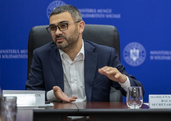
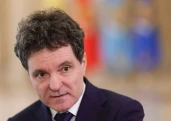
Digitalisation is a central part of the circular economy, and it should be a central strategy of the government to improve many processes of public services, the Minister of the Economy, Digitalisation, Entrepreneurship and Tourism, Irineu Darsu, said on Wednesday at the Resource Recovery Summit 2026 event.
"In a way, digitalisation is a central part of the circular economy. In another way, digitalisation should be a central strategy of the government to improve many processes of public services. One thing I would like to say is that, in recent months, in Romania, we all dreamed of full digitalisation or a digital transformation, but I believe that digital transformation begins with digital transitions, step by step, calculated in such a way as to make the optimised steps that produce the greatest impact. I think that, after 20 years or so of trying to digitalise or promising to digitalise everything, we should approach this gradually and choose, as a state, these steps very carefully, in order to have the greatest impact in the shortest time. (...) What I know for sure is that the circular economy itself, but also the Romanian government's s digitalisation agenda, will actually create jobs, even if we all know that they will no longer be the same types of jobs that we have today. (...) I think we should open up some new ecosystems where innovation can emerge from scratch at a faster pace. And I think we have the human capital in Romania to do that. I think there is increasingly more demand, but it is a matter of avoiding the barriers - sometimes bureaucratic, sometimes fiscal - that exist today on the road to innovation," Darau said.
The minister pointed out, at the same time, that the use of Artificial Intelligence (AI) in the circular economy would help more efficiently track products, resources, losses and optimisation opportunities.
"When you look at the industry as a whole and the economy as a whole, you have to think about several types of products and resources. I think that, overall, if we want to get the highest return on investment, we should focus on a smart collection infrastructure, let's say powered by digitalisation. Because a circular economy is incredibly complex and we should follow the product and resources from their creation, through use, to collection and, eventually, rebirth. Of course, on this path we should not disadvantage or leave SMEs helpless, because they represent the backbone of the economy and must be accompanied in the digitalisation process, so that they can exist effectively in the middle of this chain, hold all the information and be able to reuse certain products and resources. I also think that by using Artificial Intelligence we could have a "T0" moment. With the help of AI, this type of tracking of products, resources, losses, and optimisation opportunities could be identified much faster and more accurately. In the end, I think that, in order to make all these private investments viable, the government should set an example. The government, through public procurement, should buy more goods with a minimum content of recycled material," Darau said.
The Romanian Government, through the Ministry of the Environment, Water and Forestry (MMAP), organised on Wednesday the Resource Recovery Summit 2026 event, in collaboration with the Green Revolution Association and with support from Envipco and RetuRo.















Comentează