



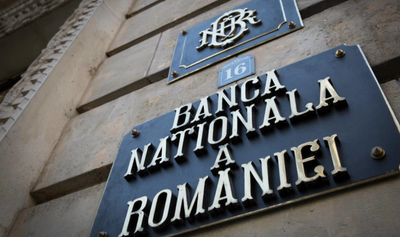


The Board of Directors of the National Bank of Romania (BNR), meeting on Tuesday, decided to maintain the monetary policy interest rate at 6.50% per year, the BNR informed in a press release.
According to the cited source, the Board of Directors also decided to maintain the interest rate for the lending facility (Lombard) at 7.50% per annum and the interest rate for the deposit facility at 5.50% per annum, as well as to maintain the current levels of the minimum reserve requirements for liabilities in lei and foreign currency of credit institutions.
"Based on the assessments and data currently available, as well as in the conditions of high uncertainties, the BNR Board of Directors decided in today's meeting, February 17, 2026, to maintain the monetary policy interest rate at the level of 6.50 percent per annum. At the same time, it was decided to maintain the interest rate for the lending facility (Lombard) at 7.50 percent per annum and the interest rate for the deposit facility at 5.50 percent per annum. Also, the BNR Board of Directors decided to maintain the current levels of the minimum reserve requirements for lei and foreign currency liabilities of credit institutions," the press release reads.
The decisions of the BNR Board of Directors aim to ensure and maintain price stability in the medium term, in a manner that contributes to achieving sustainable economic growth. The Board of Directors reiterates that, in the current context, the balanced mix of macroeconomic policies and the implementation of structural reforms, including through the use of European funds to stimulate long-term growth potential, are essential for macroeconomic stability and strengthening the capacity of the Romanian economy to cope with adverse developments.
"BNR is closely monitoring developments in the domestic and international environment and is prepared to use the instruments at its disposal in order to achieve the fundamental objective of price stability in the medium term, while maintaining financial stability," the aforementioned source states.
BNR emphasizes that the annual inflation rate was on a slowly decreasing slope at the beginning of the fourth quarter of 2025, decreasing in December to 9.69%, from 9.88% in September, under the impact of the significant declines in the dynamics recorded during this period in the price of fuels and the prices of LFO (Vegetables, Fruits, Eggs).


On the other hand, the annual adjusted CORE2 inflation rate continued to increase during the fourth quarter of 2025, up to 8.5% in December, from 8.1% in September, amid persistent influences from wage cost dynamics and the high level of short-term inflationary expectations, which were joined by those arising from indirect effects of the increase in the price of electricity, as well as from the increase in the prices of some agri-food commodities and the leu/euro exchange rate.
"Over the year 2025 as a whole, the annual inflation rate increased by 4.55 percentage points (from 5.14 percent in December 2024), mainly as a result of the direct transitory effects exerted by the expiry on July 1 of the electricity price cap scheme and the increase starting on August 1 of VAT and excise duty rates. The annual inflation rate calculated based on the Harmonized Index of Consumer Prices (HICP - inflation indicator for EU Member States) rose to 8.6 percent in December 2025, from 5.5 percent in December 2024. The average annual CPI inflation rate increased to 7.3 percent in December 2025, from 5.6 percent in December 2024, and the average annual inflation rate calculated based on the HICP increased to 6.8 percent in December 2025, from 5.6 percent in December 2024. percent in December 2025, from 5.8 percent in December 2024," the statement said.
The National Bank reports that, in January 2026, the annual inflation rate decreased marginally, to 9.62%, under conditions in which the declines in dynamics recorded this month in the energy and fuel segments were largely offset by the impact of the acceleration of the increase in administered prices and LFO prices, and the adjusted CORE2 annual inflation rate remained at 8.5 percent.
According to preliminary data, economic activity contracted by 1.9% in the fourth quarter of 2025, after decreasing by 0.1% in the third quarter (quarterly change), while its annual dynamics decreased to 0.1% in the fourth quarter of 2025, after increasing to 1.7% in the previous quarter. For the whole of 2025, the economy thus slowed down its growth to 0.6%, from 0.9% in 2024.
Year-on-year developments were relatively mixed across aggregate demand components and major sectors in the last three months of 2025, as suggested by high-frequency indicators. Thus, in the fourth quarter of 2025, retail sales declined further year-on-year, while industrial production contracted slightly, after recovering somewhat in the previous three months. The annual dynamics of the volume of construction works remained consistently positive in the period October-November 2025, but decreased considerably compared to the third quarter, while the annual variation of exports of goods and services increased its positive gap compared to that of imports in October-December 2025, recording a relatively more modest decrease compared to the third quarter of 2025.
Against this background, the trade deficit further accentuated its contraction in annual terms in the fourth quarter of 2025, and the current account deficit only slightly widened compared to the same period of the previous year, even in the conditions of the pronounced deterioration of the income balances. Thus, for the whole of 2025, the trade balance deficit contracted slightly, and the current account deficit considerably moderated its growth, BNR explains.
Regarding the number of employees in the economy, it slowed down its decline in October-December 2025 compared to previous months, but recorded a moderate contraction compared to the similar period last year, while the ILO (International Labor Office) unemployment rate recorded, in turn, a small decrease for the entire fourth quarter of 2025, from the average value of 6.1% to which it rose in the previous quarter.
The annual dynamics of the nominal gross wage continued to decrease in the period October-December 2025, but much slower than in the first three quarters of the year, and that of the unit labor cost in industry increased again throughout the fourth quarter of 2025. However, the specialized surveys from January 2026 indicate an obvious weakening of hiring intentions in the very short term, after a slight recovery in the fourth quarter of 2025, as well as a sharp decrease in the labor shortage reported by companies, the central bank also emphasizes.
The cited source also mentions that the main interbank money market quotations continued to decrease in the first month of the current year, returning to the levels of April 2025. At the same time, medium and long-term yields on government securities have accentuated their downward trend, reaching lows of the last 18 months, including in the context of the improvement of investors' perception of the risk associated with the economy and the local financial market, as a result of the favorable results of the budget execution for 2025.
The leu/euro exchange rate recorded a pronounced decrease in the first days of January 2026, but then gradually returned to the higher levels from the end of the previous month, while against the US dollar, the leu continued to weaken in the first half of the month, but strengthened relatively sharply later, given the significant depreciation of the US currency on international financial markets.
The annual growth rate of credit granted to the private sector continued to decline in December 2025, reaching 6.2%, from 6.8% in November, under conditions in which the variation of the lei component slightly accelerated its decline, due to the evolution of loans to non-financial corporations, and the pace of foreign currency credit significantly slowed down its rise. The share of the lei component in credit granted to the private sector thus decreased to 68.2% in December 2025, from 68.7% in November.





















Comentează