



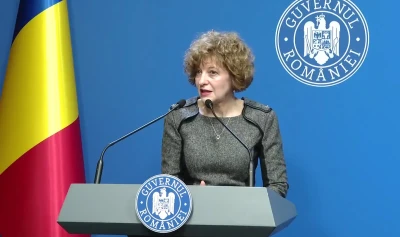


Deputy Prime Minister Oana Gheorghiu said on Tuesday that Romania must adopt a new model of economic growth, based on competitiveness and innovation, in order to avoid stagnation in terms of real convergence, known in the specialist literature as the 'middle-income trap'.
The remarks were made at the Victoria Palace during the debate 'Romania: Economic Growth Based on Competitiveness', organised by the Government in partnership with the World Bank Group, agerpres reports.
'For some time, Romania has followed a model that delivered results - competitive labour costs and strong domestic consumption. But this model is now approaching its limits. Wage convergence is advancing, but productivity growth must also accelerate. If we want to avoid what economists call stagnation in real convergence - that is, the middle-income trap - we must go further; we must make a shift based on competitiveness and innovation, which is no longer optional,' Oana Gheorghiu said, according to the translation provided by the organisers.
The Deputy Prime Minister stressed that competitiveness is not limited to research and technology, but also entails economic discipline, functional institutions and high-performing companies, including state-owned enterprises.
'We cannot credibly speak about smart growth while public enterprises generate chronic losses, fail to create value and operate without any professional governance. Reforming state-owned enterprises is therefore not a separate issue; it is an essential component of changing the economic model. Genuine governance, the professional and transparent selection of boards, managerial accountability and financial discipline are not technical details. They are key conditions for competitiveness, for budgetary sustainability and for public trust,' Gheorghiu stated.
She also detailed the elements that should accompany a successful economic transition, noting that it must focus on creating new activities and companies capable of replacing unviable sectors.
'Successful transitions are dynamic - they involve creating new activities and new companies to replace what is no longer viable, while adapting to the surrounding context and making full use of our resources. That includes talent, capital and energy. Talent is the scarcest resource. Countries that have moved rapidly from middle to high income share several characteristics: they have protected entrepreneurship and free enterprise, imposed discipline on revenues and safeguarded them in relation to performance, developed human capital and rewarded merit, and used moments of pressure to reform institutions and public policies that were no longer fit for purpose,' Gheorghiu said.
In this context, the Deputy Prime Minister pointed out that Romania must make full use of the European Union's institutional and financial framework, including the future European Competitiveness Fund, designed as a centralised instrument for strategic technologies.


'What matters is an enabling environment, a dynamic private sector and stable, predictable rules, a merit-based administration and a state that acts as a responsible shareholder, not as a passive or inconsistent manager,' Gheorghiu explained.




















Comentează