



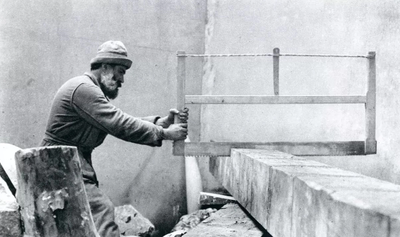


In the courtyard of the Constantin Brancusi National Museum in Targu Jiu, the Small Table and the trovants, lesser-known works by Constantin Brancusi, the titan from Hobita, tell a unique story, lost in time but not forgotten.
In Targu Jiu, the artist created his most precious work, the Calea Eroilor/Heroes' Path monument ensemble, comprising the Table of Silence, the Alley of Chairs, the Gate of the Kiss and the Endless Column.
Linked to the Table of Silence is also the Small Table, or Rejected Table, a Category A monument on which no intervention has ever been carried out in the decades since it was created, remaining in the form left by the sculptor.
It bears the marks of the passage of time and weathering, which makes it all the more interesting and distinctive, even though it is not as well known as its sister', the Table of Silence, located in the Central Park in Targu Jiu.
The Small Table is now located in the courtyard of the Constantin Brancusi National Museum in Targu Jiu, although over time it has also been placed in other locations.
The works in the courtyard of the Constantin Brancusi National Museum were treated as rejects by the authorities, which is why they are not very well known, not even to the public in Targu Jiu, let alone to visitors from the country or abroad, who are very surprised when they learn that there are two more works created by Constantin Brancusi in Targu Jiu. One of them is the Small Table, which has indeed also been called the Rejected Table, but also the Festive Table. It is a Category A listed monument, like the Table of Silence, of universal interest as such and it has not so far been subject to any restoration, conservation or biocide treatment process, but remains in the form in which it was left by Constantin Brancusi. According to the writings of Ion Mocioi, it was left disassembled and was later assembled and placed both near the Endless Column, that is on the axis of the ensemble beyond the Endless Column, and for a period in the Constantin Brancusi Park, where the stone works are located. It was subsequently brought to the courtyard of the Barbu Ganescu House, which is currently the headquarters of the Constantin Brancusi National Museum,' Denisa Suta, manager of Constantin Brancusi National Museum in Targu Jiu, told AGERPRES.
The Small Table was practically born' from the legs of two stone tables.
Constantin Brancusi ordered this stone table to place it within the Calea Eroilor monumental ensemble. He was dissatisfied with its dimensions, finding them as being too small, and therefore ordered another, larger table and when this too arrived, the great artist decided to superimpose the tops of the two tables, resulting in the Table of Silence located within the Calea Eroilor monumental ensemble, while from the legs of the two tables came this table, the Small Table, which is in the courtyard of the Barbu Ganescu House, headquarters of the Constantin Brancusi National Museum,' the quoted source added.

During the period in which he worked on the Calea Eroilor ensemble, between 1937 and 1938, Brancusi lived in the Barbu Ganescu House, now the museum's headquarters, and during that time he also created an artistic installation.
He was in a way also a pioneer in terms of artistic installations. He called it the Garden with Stone Creatures, but this installation is listed among historic monuments under the title Tables Arranged by Constantin Brancusi. They are composed of trovants with millstones and also some zoomorphic stones, with various shapes imagined by the sculptor, animals, frogs, fish and so on, which he arranged in the courtyard of the house. The millstones were found here at the family who hosted him and the river stones appear to have been brought by him from the rivers in the Sacelu area, from the Blahnita river. The trovants are no longer in their original state, as there was once another millstone placed on top of them, so that the installation resembled a genuine round table in the style of traditional round tables in Romanian homes. Only the millstones forming the base of the work remain, along with nine trovants and some of the river stones. We know that some of the trovants are also on the alley at the entrance to the Art Museum in Targu Jiu and one of the trovants was placed in front of the Virgil Madgearu High School. That one was unfortunately painted, it was altered,' Denisa Suta added.
The trovants, like the Small Table, also bear the marks of time, which makes the works more interesting, as any intervention would somehow destroy the imprint left by Constantin Brancusi.'
We manage them, they are owned by the Administrative Territorial Unit of Targu Jiu City Hall and we have had them under our administration for a short period, I believe we received them last year through a handover protocol. A Local Council decision had been issued earlier, but the handover report was signed last year and only once we became administrators could we take certain measures regarding their restoration. We have consulted specialists and most of the sculptors and experts who have come have considered that an intervention would somehow destroy the imprint left by Constantin Brancusi. Being outdoors, they are subject to these temperatures, humidity, temperature differences, frost, thaw and so on and during damp periods they are affected by moss and lichens. We will consult specialists in the near future, once we have the necessary funds and in consultation with specialists from the National Heritage Institute, to determine whether it is appropriate to intervene or whether it is better for them to remain in the state in which the sculptor Constantin Brancusi left them,' the museum manager said.
In the future, plans are in place to enhance these works as part of a project aimed at restoring the headquarters of the Constantin Brancusi National Museum and implicitly its courtyard.
We have submitted a project and have been accepted to enter a restoration process for the museum headquarters and of course the park, meaning that the landscaping of the premises will also be carried out under the Cultural Foundations project, agreement four, which is an agreement with the Council of Europe Development Bank. It is a loan. Half will be granted as a loan from the Council of Europe Development Bank and half will be provided by the Romanian Government. During this period we have begun the procedures to obtain the necessary documentation. We have submitted applications to Targu Jiu City Hall and are still waiting and we hope to receive them as soon as possible so as not to delay the start of the restoration procedure because we risk being held up by the issuance of certain documents such as the urban planning certificate, for example. We need these documents from Targu Jiu City Hall in order to forward them to the project management unit, which is the unit under the Ministry of Culture responsible for implementing this framework agreement with the Council of Europe Development Bank and once restoration works begin, the actual technical design will be drawn up and then we will certainly consider enhancing the works as well,' the manager explained.
According to her, the project includes 14 historic monuments of national interest.
For the time being the costs are not known until the documentation is prepared, up to the DALI [Documentation for the Approval of Intervention Works] stage and subsequently the technical design. These are the amounts negotiated under this framework agreement which includes 14 historic monuments of national interest to be financed under this project, it is a total amount and the specific sums have not been allocated. There are only approximate amounts evaluated by specialists within the projects on the basis of the concept note and design brief that were prepared, but the sums will only be known once the technical design has been completed. We have also proposed converting the attic, because it is very high and this would create additional space where the administrative offices could be moved, leaving the ground floor and basement solely as exhibition spaces. At that point we could also organise a permanent exhibition. For the time being, as you know, the space is quite limited, we only have the ground floor available where we organise temporary exhibitions,' Denisa Suta mentioned.
On 19 February, 150 years since the birth of the Gorj sculptor will be marked, an occasion on which the Romanian Graphics - BRANCUSI 150 exhibition will be opened simultaneously in Targu Jiu and in 20 other countries across six continents, organised by the Constantin Brancusi National Museum and the Aiud Inter-Art Foundation.






















Comentează