





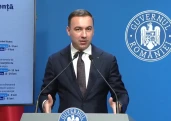
Romgaz will be technically ready to enter the market once the price cap is lifted on 1 April, the company CEO, Razvan Popescu, said on Monday at a specialist conference.
"We started last year and have made progress on the entire IT side, integrating supply systems into the Romgaz system, and we have purchased the necessary servers. From a technical point of view, I believe we will be ready, once the cap is lifted on 1 April, to operate on the market. Obviously, much depends on the volumes allocated to us under the emergency ordinance, because in previous years Romgaz had somewhere between 60% and 80% of its volumes allocated under the ordinance. The draft emergency ordinance has been put out for consultation but has not yet been approved. We have not yet received the allocated volumes; we will probably receive them in the coming period, and then we will be able to outline our strategy for the year ahead. In any case, even with this allocation, we maintain our objective of becoming a supplier and will enter both the household and the small non-household segments," he said, told Agerpres.
Popescu added that the draft emergency ordinance is clearer in terms of how the final price is formed.
"Romgaz has acted as a pillar of stability since 2022, when Emergency Ordinance 27 was introduced. Other ordinances followed. This one, based on the model we have seen, is somewhat clearer in terms of the way the final price is calculated. It will no longer put pressure on Romania's budget because the 0.31 gap no longer exists, and it provides transparency in how the natural gas price is formed for the final customer. We can see that the production component accounts for less than half, meaning that the actual influence of the production price on the final price paid by consumers is around 40%," he said.
Regarding gas prices, Razvan Popescu believes that the Neptun Deep project will put downward pressure on them.
"The energy transition has clearly stated that gas is a transition fuel, and many oil and gas companies have shifted more towards green energy. In my view, that was the correct approach, given the Net Zero objective and the completion of the energy transition by 2050. At present, 2050 appears to be a very ambitious target, and carbon capture and storage technologies are still at an early stage, especially in Europe. However, the fact that Neptun will bring 8 billion cubic metres to the regional market, where consumption is around 30 billion, will certainly put pressure on prices. The estimates we have seen for the future suggest that the TTF price will fall and that there will be a correlation between the European TTF price and US LNG, naturally adding liquefaction, transport and regasification costs. Expectations that the TTF price would fall have existed for about a year, but they have not materialised so far; nevertheless, these are the current expectations. If we look strictly at Romania during the summer period and generally in recent years, the price has been below TTF. There have been moments of peak consumption when it was indeed higher, but due to these ordinances, the final price paid by household consumers and heat producers has been capped. They have not been affected by short-term fluctuations on either the Romanian market or the TTF," the Romgaz CEO added at the ZF Power Summit 2026: Energise the economy.
Last week, the Ministry of Energy published the draft emergency ordinance aimed at continuing the protection of household natural gas consumers between 1 April 2026 and 31 March 2027. Under the draft, for consumption during that period, the final price invoiced by natural gas suppliers to household customers, as well as to heat producers for the quantity of gas used to produce thermal energy in cogeneration and heating plants supplying the population, will be set by each supplier as the sum of four components: the purchase component (calculated under a new formula included in the ordinance), the supply component (15 lei/MWh), the component represented by regulated tariffs set in accordance with Energy Regulatory Authority rules, and the component represented by VAT and excise duties.
According to the explanatory note accompanying the draft, natural gas producers carrying out both onshore and/or offshore extraction activities, regardless of when these activities began, and gas sales activities are required to supply the necessary volumes of domestically produced natural gas at a price of 110 lei/MWh (down from the current 120 lei/MWh) to suppliers and heat producers, but only for the quantity used to generate thermal energy in cogeneration and heating plants serving the population that have opted to purchase gas directly from producers.



























Comentează