



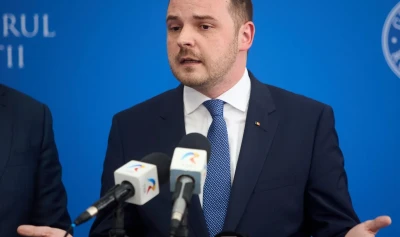


Romania is not currently experiencing a medicine crisis, Health Minister Alexandru Rogobete said on Tuesday.
"At the moment, we are not in a crisis. The reason why we have set up, at the level of the Ministry of Health, the inter-institutional group formed by the Ministry of Health, the Unifarm Company, the Antibiotice Iasi Company, the National Medicines Agency is to monitor, on the one hand, the stocks for critical medicines that we have in Romania and, on the other hand, the price fluctuations or possible discontinuities that may occur in the production and delivery of medicines. There are signals at an international level in this regard and the group has a rather preventive role, namely to be able to anticipate possible production shortages or discontinuities in production and delivery and to be able to orient ourselves towards other producers for those medicines if the situation arises. I emphasize and say it again - today we are not in a crisis, but we are monitoring the international market in order to be able to reduce as much as possible "maybe the negative effects of possible future discontinuities, if necessary," said the Minister of Health, after participating in the round table "Addictions in children and adolescents", hosted by the Presidential Administration, within the "Romania in Light" project.
He said that the group set up by the Ministry of Health is connected to the European Medicines Agency and was created to avoid supply disruptions for certain medicines.
"In Romania, they are divided into two categories: the category of those with prescription, those reimbursed by CNAS or the Ministry of Health where the price is regulated by the Ministry of Health and there, if price pressure appears, because there may be situations, for example, in which the cost of transportation for a medicine is three times more expensive than the medicine itself. Then obviously certain financial adjustment mechanisms may appear there, but there we can control the price. There are also OTC medicines, that is, those without prescription and without compensation, where the Ministry of Health cannot intervene and cannot correct the price, but they can be somewhat compensated and corrected from the fiscal decisions that are taken on the fuel sector. With the capping or reduction of certain excise duties or certain costs in the fuel area, including for medicine transporters, obviously a decrease will also be seen in the price of distribution," explained Rogobete.
According to him, there are other companies besides those in the Middle East with which contacts could be signed for the raw materials necessary for the production of medicines.
"I'm not just talking about fuel prices, but we're also talking about production plants in the Middle East, which are currently affected, we're talking about the import of raw materials into Europe from those areas, which is also affected. Then it's monitored, there are other companies in the United States of America, for example, with which we don't currently have a contract, but we could have one. It's a dynamic that we'll present when syncopes or discontinuities really occur," the Minister of Health said.




















Comentează