



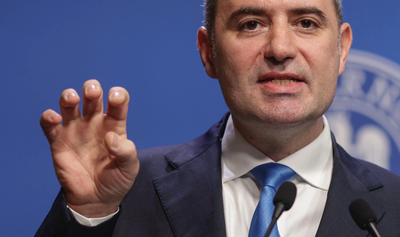


Finance Minister Alexandru Nazare on Monday stated that Accession to the Organisation for Economic Co-operation and Development (OECD) brings lower financing costs, additional investment, and represents a guarantee that institutions function efficiently, regardless of the economic cycle.
Minister Nazare made the statement in the context of the launch of the latest OECD Economic Survey of Romania and in the context in which an OECD delegation is currently visiting Romania, agerpres reports.
'I would start by saying that the entire effort to prepare this study coincided with our budget consolidation efforts. This process began in June last year, through extensive consultations with Romanian institutions and very good collaboration with OECD structures. It was discussed at the OECD Economic Analysis and Development Committee on January 13, when we presented the final data of the study across all four sub-components,' Nazare said.
According to him, Romania's performance regarding the cash deficit, which is associated with the significant adjustment of the primary and ESA deficits, was an important factor that, during the January 13 debate in Paris, had a significant impact on all OECD delegations reviewing the study, helping them form an opinion, the study being the key element that concludes the entire accession process.
'Joining the OECD not only brings a reduction in financing costs - which we need urgently to control and stabilise public debt as quickly as possible - but secondly, it will also attract additional investment, because some investors require OECD membership as a condition in their investment mandates. Once Romania meets this condition, these investors will have the country on their radar,' Alexandru Nazare explained.
He added that OECD accession also ensures better-functioning institutions, which generates economic prosperity and growth.
'Equally important, strategically, I would say that after joining the European Union - which required legislative harmonisation - and NATO - which required additional capabilities, as Romania had to demonstrate extra capacities -accession to the OECD actually and legally guarantees that institutions operate efficiently, regardless of the economic cycle,' the Finance Minister stated.


Nazare also noted that the OECD's forecasts for economic growth and cash deficit align with the government's projections, which is a very strong signal of confidence for Romania.
Romania's public finances have deteriorated significantly, posing risks to their long-term sustainability. To prevent this, the OECD states that there is a need to increase public expenditure efficiency, broaden the tax base, and improve tax compliance.
In a report published on Monday, the OECD noted that the recent pension reform - particularly the increase in retirement age for women, the limitation of special pensions, and the introduction of new indexation rules - is a positive step towards improving pension system sustainability and encouraging labour force participation. At the same time, Romania faces increasing pressure to raise spending on health, education, social assistance, and innovation to support inclusive growth. Additionally, public sector wages represent a growing share of government expenditure, which requires stricter control.


























Comentează